


Impact Update
First Quarter 2026
Confronting the Cost-of-Living Crisis
Rising costs are placing significant strain on households. Companies that respond by maintaining affordability can build trust with consumers and demonstrate a meaningful commitment to their role in society. These challenges stem not only from higher prices for goods and services, but also from widening income inequality, as wealth becomes increasingly concentrated while many workers struggle to earn a living wage.
At Domini, affordability is a core focus. As part of our investment research, we assess how companies ensure their goods and services reach the most vulnerable segments of the population, and we engage with companies that provide essential products that shape household costs. While cost-of-living pressures are influenced by public policy, tariffs, inflation, and other macroeconomic factors, the private sector plays a critical role in consumer financial well-being. We believe companies should evaluate whether their business models are durable across economic cycles and clearly articulate how they will meet consumer needs around affordability.
Our engagements this quarter addressed the cost-of-living pressures across sectors, with a focus on food, the digital divide, financial services, and auto lending.
First Quarter Engagement Overview
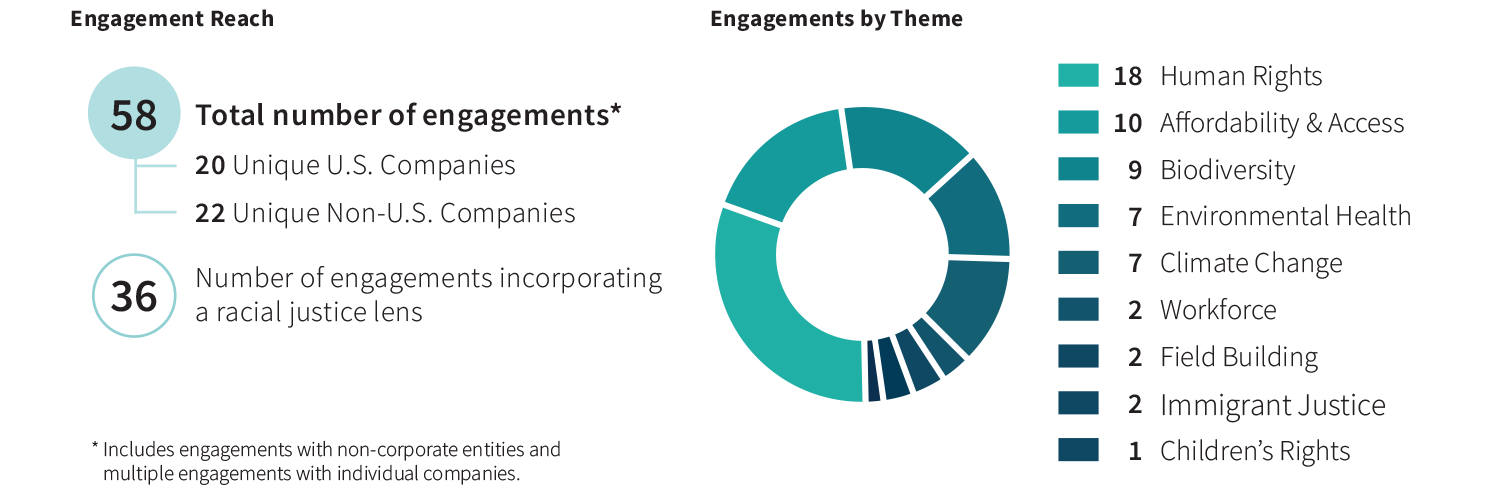
We meet with company executives to encourage stronger policies and practices on the issues that promote sustainability and can help their businesses succeed. In alignment with our Impact Investment Standards, we seek enhanced disclosures and more responsible business practices, and we aim to address emerging issues with companies. Through constructive dialogue, shareholder proposals, and proxy voting, we communicate our expectations to companies and promote universal values of fairness, equality, justice, and respect for human rights, while contributing to ecological sustainability and climate resilience. We do this work seeking positive impacts for people, planet, and profit. Read more at domini.com/engagement
*Includes engagements with non-corporate entities and multiple engagements with individual companies.
Engaging Food Companies to Prioritize Affordability



As the global cost-of-living crisis persists, affordability has become a material financial and social issue for food companies. In the U.S., grocery prices rose 23.6% between 2020 and 2024. Higher prices for essential goods have strained household budgets—particularly for lower-income consumers—contributing to food insecurity, shifting purchasing behavior, and heightened sensitivity to price increases.
Through our engagements, we encourage food companies to treat affordability as a core component of sustainable value creation. This includes ensuring that pricing strategies do not leave customers behind, especially as price increases often persist after supply chain disruptions unless actively addressed. This issue is particularly urgent given recent policy changes that have heightened eligibility requirements and eliminated some essential safety nets for families in the U.S.
We recently initiated an engagement with Kobe Bussan, a Japanese food retailer and producer, as a potential leader in affordability. Its stated vision—”more value with less price”—and vertically integrated, low-cost operating model position it well to serve consumers under sustained pricing pressure. We are seeking to understand how Kobe Bussan evaluates affordability outcomes for lower-income customers and how affordability is embedded in its business strategy. We believe this approach may offer a best-practice model for resilience in an inflationary environment.
We also engaged Gruma, a Mexican company and one of the world’s largest producers of corn flour and tortillas—staples for millions of households. While Gruma has acknowledged price sensitivity and weaker consumer sentiment, it has not clearly addressed affordability or explained how it factors into strategy and governance. We are focused on understanding how the company assesses affordability pressures, protects access for vulnerable consumers, and mitigates risks associated with pricing practices.
We also wanted to better understand how the fast-food industry is addressing these challenges, so we reached out to Chipotle Mexican Grill after it reported affordability-driven declines in visit frequency among lower- and middle-income customers. At the same time, the company has indicated a strategic focus on more affluent customers through innovation and digital experience enhancements. We are seeking clarity on how Chipotle evaluates affordability across its consumer base, whether it has long-term strategies to retain value-conscious diners, and what governance mechanisms it has in place to oversee pricing, marketing, and product decisions to avoid exacerbating affordability challenges or undermining long-term demand.
Investment Highlight: Domini Impact Equity Fund
Costco Wholesale Corporation is widely recognized for its commitment to affordability of food and everyday essentials. Its business model is designed to deliver consistently low prices on a curated selection of high-quality products. A key element of Costco’s strategy is maintaining low merchandise margins while relying on membership fees for profitability. This enables the company to minimize product markups and pass savings directly onto consumers. Its limited product assortment, bulk purchasing, private-label offerings (Kirkland Signature), and streamlined warehouse operations all contribute to sustaining low prices at scale. Despite inflationary pressures and tariffs, Costco has remained committed to keeping costs as low as possible and supporting household purchasing power. CEO Ron Vachris emphasized this approach, telling investors recently, “We will never succumb to not being the best price and driving prices down for our members. That’s what Costco is known for. That will always be our leading mantra.”
Closing the Digital Divide: Affordability and Access to Connectivity


Access to affordable, reliable broadband has become essential for economic participation, yet millions of people remain digitally excluded. More than 40 million Americans—primarily in small towns and rural communities—lack access to Internet service at speeds necessary to pursue education, secure employment, and operate competitive businesses, making the digital divide a major driver of regional inequality. While only 1.5% of urban residents lack access to fixed broadband, that figure rises to 22.3% in rural communities and 27.7% on Tribal lands. These gaps exacerbate existing disparities and limit access to health care, education, government services, and economic opportunity.
Bridging the digital divide requires coordinated action from the private sector, including significant investment in infrastructure and affordability. Thin markets are a key barrier. In rural and low-income areas, high upfront infrastructure costs and limited financing reduce incentives for providers, resulting in fewer—or no—service options. In this context—and with shifting government support—affordability and pricing practices are critical determinants of meaningful access.
This quarter, we initiated engagements with two companies playing different roles in the connectivity ecosystem. Comcast, a major broadband provider, has notable philanthropic efforts to help expand Internet access and digital opportunity as part of its “Project UP” initiative, including community partnerships throughout the U.S. and “Lift Zone” digital hubs that provide free WiFi access. While these initiatives help address short-term access needs, we are seeking greater clarity on how affordability is embedded structurally within its business model, including pricing strategies and eligibility thresholds to widen the reach of discounted programs.
We also reached out to Ciena, a key supplier of networking equipment critical to broadband and AI infrastructure. While it does not serve consumers directly, its role in network efficiency and energy use influences downstream costs for customers. We are encouraging greater transparency on how efficiency gains translate into affordability for end users, including strengthened disclosure around affordability-related risks and KPIs.
For investors, affordability and connectivity are central to resilient growth, system stability, and inclusive long-term value creation.
Investment Highlight: Domini Impact International Equity Fund & Domini Impact Bond Fund
Vodafone Group plc, a UK-based multinational telecommunications company, is working to overcome access barriers and expand connectivity in underserved and unserved regions throughout Europe and Africa. As of March 2025, its 5G network covered 75% of Europe’s population, while 4G coverage in Africa reached 76%. Through its participation in the UN Partner2Connect digital coalition, Vodafone has committed to bringing 4G to an additional 70 million people in sub-Saharan Africa, including in four of the least developed countries—Mozambique, Tanzania, Lesotho, and the Democratic Republic of the Congo. Since joining the initiative in 2022, it has reached 13.8 million more people. It is also part of the 2Africa Consortium, developing the world’s largest subsea cable system, which will connect 33 countries across Europe, Africa, and Asia. Beyond expanding network infrastructure, Vodafone is also addressing barriers around affordability, awareness, and digital literacy and skills. It is working to make smartphones more accessible in Africa by providing low-cost entry-level devices, affordable financing programs, and local assembly to reduce import duties.
Trust, Transparency, and Affordability in Financial Services


For many households, cost-of-living pressures first appear in financial services: late fees, add-on products, loan extensions, and opaque marketing that can hide the true cost of banking access. Practices related to loan affordability, fee structures, repayment schedules, marketing, and disclosure can either alleviate or worsen financial stress for vulnerable customers.
This raises questions for banks and lenders about whether their business models prioritize transparency and accessibility or promote practices that shift risks and costs onto vulnerable customers. By providing transparent pricing without hidden fees, loans that are priced to each customer’s ability to repay, and innovative options for customers facing hardship, companies can strengthen customer loyalty and build resilience. In contrast, predatory or misleading practices can erode customer and employee trust and increase legal and regulatory risks.
This quarter, we reached out to Capital One, recognizing its leadership in eliminating overdraft and non-sufficient fund fees. However, the company has also faced regulatory scrutiny into deceptive marketing practices around credit cards and savings accounts, including allegations that customers were misled into paying extra for credit card products and remaining in lower-interest accounts. In June 2024, Capital One paid a $16 million settlement to resolve a class action lawsuit alleging that it illegally charged fees for returned checks or ACH debit transactions. All of this raises concerns around whether the company has appropriate oversight and risk controls in place. We hope to see the company strengthen its governance practices to ensure that products are designed and marketed to serve the well-being of customers.
We also engaged Spain’s Banco Santander, which has faced regulatory scrutiny in several jurisdictions related to allegations of customer harm, including placing subprime borrowers into auto loans that it knew had a high probability of default. While Santander has taken steps to strengthen governance, underwriting, and oversight, we are seeking clarity on how these reforms translate into improved affordability outcomes.
In both cases, we are urging these banks to establish stronger guardrails around product design to ensure they are not putting vulnerable customers at risk. We are also seeking to better understand their credit risk assessment policies and encourage robust accountability and remediation mechanisms to help ensure fair treatment of customers.
Investment Highlight: Domini Sustainable Solutions Fund
Based in Tokyo, Resona Holdings is a Japanese retail and commercial banking group with strong commitments to sustainability, customer-oriented business conduct, transparency, and access. The company has aligned its banking model with the needs of individuals and small and medium enterprises (SMEs), and it seeks to contribute to socioeconomic development of local communities. As of March 31, 2025, loans to individuals and SMEs accounted for about 80% of its loan portfolio. Under its retail transition financing framework, Resona has committed to providing ¥10 trillion (~$63 billion USD) by 2030, including financing for renewable energy projects, sustainability-linked loans, SME loans linked to specific environmental or social targets, and housing loans conforming to energy-saving standards. As of March 2025, it had delivered ¥5.7 trillion (~$36 billion USD) toward this goal.
Rising Auto Debt and Borrower Risk

U.S. auto loan debt has reached record levels, exceeding $1.66 trillion. This has been accompanied by rising delinquencies, defaults, repossessions, and consumer complaints. At the same time, the financial burden on consumers continues to grow. The average monthly auto payment is now approximately $745, with nearly one in five borrowers paying $1,000 or more. In this context, lending practices can either mitigate or exacerbate financial stress. Ensuring accuracy, fairness, and transparency is essential to avoid compounding affordability pressures and to mitigate regulatory, legal, reputational, and customer retention risks.
This quarter, we engaged two private companies held in the Domini Impact Bond Fund that provide access to capital for auto financing. Lendbuzz is an AI-powered platform that uses alternative data to support auto lending for borrowers with thin or no credit histories. This nontraditional approach represents an important contribution to financial inclusion but also heightens the importance of strong safeguards around bias, discrimination, and fair decision making. Given limited disclosure, we wrote to Lendbuzz to better understand: (1) the safeguards in place to mitigate bias in its AI models and creditworthiness decision processes, and (2) its approach to affordability, including risk assessment, pricing transparency, and support for borrowers facing financial hardship.
We also engaged Prestige Financial Services to better understand how it assesses affordability risk throughout the life of a loan, including early-warning indicators of default, as well as its pricing and fee structures. Given rising defaults nationwide, we also asked about its servicing and collections practices and whether guardrails are in place to support struggling borrowers and prevent unnecessary distress or repossessions. Across both engagements, we are pressing for stronger governance, more robust controls, and clearer disclosures to better understand how these companies manage risk and deliver positive outcomes for borrowers.
Investment Highlight: Domini Impact Bond Fund
Lendbuzz is a digital auto lending platform focused on expanding access to credit for borrowers with limited or no credit history. Its mission is to “develop innovative technologies that provide underserved and overlooked borrowers with better access to credit.” The company partners with auto dealers and offers an end-to-end loan origination and servicing platform for new and used vehicle purchases and refinancing. Its AI-powered approach evaluates alternative data, including banking history, to assess creditworthiness beyond traditional credit scores. This model has enabled thousands of individuals to access auto financing who might otherwise have been excluded, while also supporting more sales opportunities for dealership partners.
Domini Impact Bond Fund: Impact Theme Allocations*
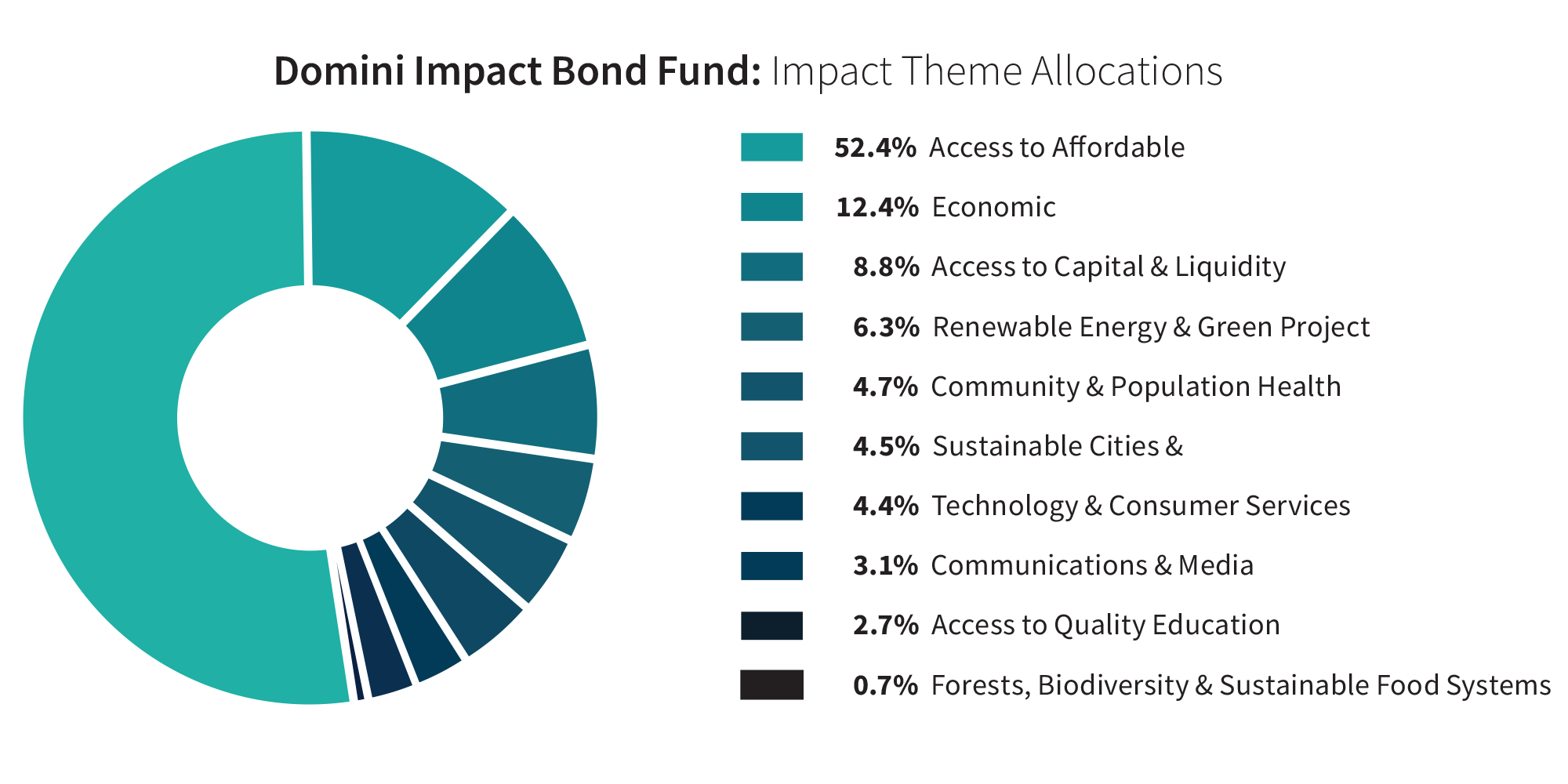
* Based on portfolio holdings as of 3/31/2026, excluding cash & cash equivalents, cash offsets, futures, swaps and options with the exception of short-term U.S. Agency bonds, which are reflected in this reporting. Numbers may not sum to 100% due to rounding. The composition of the Fund’s portfolio is subject to change. Visit domini.com to view a list of the Fund’s holdings.
A Closer Look at How Companies Can Support Affordability
By Mary Beth Gallagher, Director of Engagement

At Domini, we seek to invest in companies that produce high-quality, safe, and useful products that contribute positively to communities. Our industry-specific key performance indicators (KPIs) are designed to evaluate how companies deliver on this commitment, including whether their products and services are broadly accessible, without discrimination, and advance the right to an adequate standard of living.
We recognize that income inequality and the rising cost of essential goods and services create, not only challenges for individuals and companies, but also systemic risks across society and the broader economy. Inequality contributes to social fragmentation and suppresses long-term economic growth, affecting markets as a whole and, ultimately, the companies across our portfolios.
The case for companies to adopt affordability strategies is strong:
- Demand resilience: Companies risk losing customers if they price their products beyond what customers can afford or are willing to pay. During periods of economic uncertainty, middle- and low-income customers—and other price-sensitive segments—are more likely to reduce or forego discretionary spending.
- Customer attrition and loss of trust: When consumers have a choice of where to shop, they may avoid companies they perceive as unfair, including those with excessive executive compensation or large pay disparities. This is particularly true when paired with rising prices. Research shows 60% of Americans abandon purchases when pricing is unclear, such as when hidden fees are introduced. Customer churn and brand switching can significantly increase customer acquisition costs.
- Business model strength: Business models that depend on hidden fees or regular price increases are unlikely to be sustainable over the long term. Companies are better positioned when they invest in innovation and offer clear value propositions aligned with customer needs.
- Regulatory and legal risk: Companies may face litigation or regulatory penalties related to opaque pricing, hidden fees, or other harmful practices. This diverts capital and management attention away from core business operations.
To inform our expectations, we draw on frameworks such as the SASB Standards and the World Benchmarking Alliance’s Urban Benchmark. Our expectations for companies include:
- Conduct human rights impact assessments focused on affordability and inequality, particularly for essential goods and services. Companies should identify which customer groups are most affected by barriers and engage stakeholders to understand their needs.
- Clearly articulate a company position on affordability, including how products and services remain accessible to low-income and marginalized communities.
- Provide transparent, understandable, and predictable pricing structures. Explain pricing strategies and the rationale behind price increases. This is especially important given the rise of dynamic and algorithmic pricing models.
- Ensure nondiscriminatory pricing practices. Prices should be set in a way that is equitable, fair, and does not disproportionately impact specific groups, including by race, gender, or geography.
- Develop innovations that expand access to affordable, high-quality products. Consider options for reducing costs, such as private labels, while avoiding unintended negative impacts on human rights, such as undue pricing pressure on key suppliers.
- Avoid harmful practices that contribute to cost-of-living challenges, including anti-competitive behavior and predatory pricing.
Domini News

Amy Domini Delivers Keynote Address at Annual Symposium on Integral Ecology
What does it mean to invest with purpose? In February, Domini Founder and Chair Amy Domini delivered the keynote address at Siena University and the Laudato Si’ Center for Integral Ecology’s annual symposium, Reimagining Economy: For People and Planet. The event explored how economic systems can better serve human dignity and the environment, grounded in Franciscan values and care for creation.
Amy has spent over four decades building the case that the way we invest is inseparable from the impact we have on the world. She shared that conviction with an audience of students, scholars, faith leaders, and community partners, painting a vision of a world in which capital markets are redirected toward fairness, equality, long-term sustainability, and respect for human rights.
You can watch Amy’s full speech at domini.com/siena.

Upcoming Events
At Domini, we believe in the power of community. By sharing knowledge and learning from our partners inside and outside of the financial community, we can scale our impact and build a better future today. We’re looking forward to taking part in several impactful events this quarter:
- UNICEF Child Lens Investing Talks: UNICEF developed Child-Lens Investing in partnership with investors and experts across the financial sector to encourage integration of child-related considerations into investment decisions and processes. On April 13, Domini’s Director of Engagement, Mary Beth Gallagher, will be participating in a webinar exploring how investors can identify, measure and act on child-related impacts. Mary Beth and other panelists will share their experiences of considering child rights impacts in company assessments, engagements, and cross-sectional work.
- TIIP Symposium on System-Level Investing: On April 14, we’ll be participating in The Investment Integration Project’s (TIIP) 5th Annual Symposium on System-level Investing: From Ambition to Action. System-level risks, including climate instability, inequality, financial concentration, and democratic fragility, are increasingly shaping portfolio outcomes. Yet most investment institutions remain organized around asset-level optimization rather than system-level management. This year’s symposium will be focused on implementation—how institutions are embedding system-level risk into fiduciary practice, governance, and portfolio management. Domini CEO Carole Laible will be sharing a case study on lessons learned from a decade of implementing system-level investment practices.
- San Francisco Climate Week: In connection with San Francisco Climate Week—a citywide gathering focused on accelerating climate solutions and sustainable innovation—CAPTRUST and Financial Women of San Francisco will be co-hosting an event on sustainable investing on April 20. Domini CEO Carole Laible will be participating in the conversation, which will explore the evolution of sustainable investing from its early foundations to its role today as a powerful tool for aligning investments with values to drive a positive impact.
- US SIF Forum 2026: Domini is excited to be sponsoring US SIF’s Annual Conference taking place this year in Washington, DC on June 24-26. This annual event is the largest U.S. convening of sustainable investing leaders, bringing together capital markets actors and thought leaders for two days of educational content, advocacy, and impact. Domini CEO Carole Laible will be participating in a panel discussion examining how investors and financial advisors can translate systemic events into disciplined, household-level planning without overreacting to market noise and rhetoric.
Sustainable Development Goals
In the decade since United Nations member states adopted the 2030 Agenda for Sustainable Development, the Sustainable Development Goals (SDGs) have been widely embraced by governments, civil society organizations, companies, and investors. The SDGs aim to address broad global topics such as poverty eradication, food security, protection of forests, sustainable cities economic growth, gender equality, and climate change. Engagement highlights in this report are flagged with SDGs they are helping support. Learn more about our support for the goals at domini.com/sdg
