

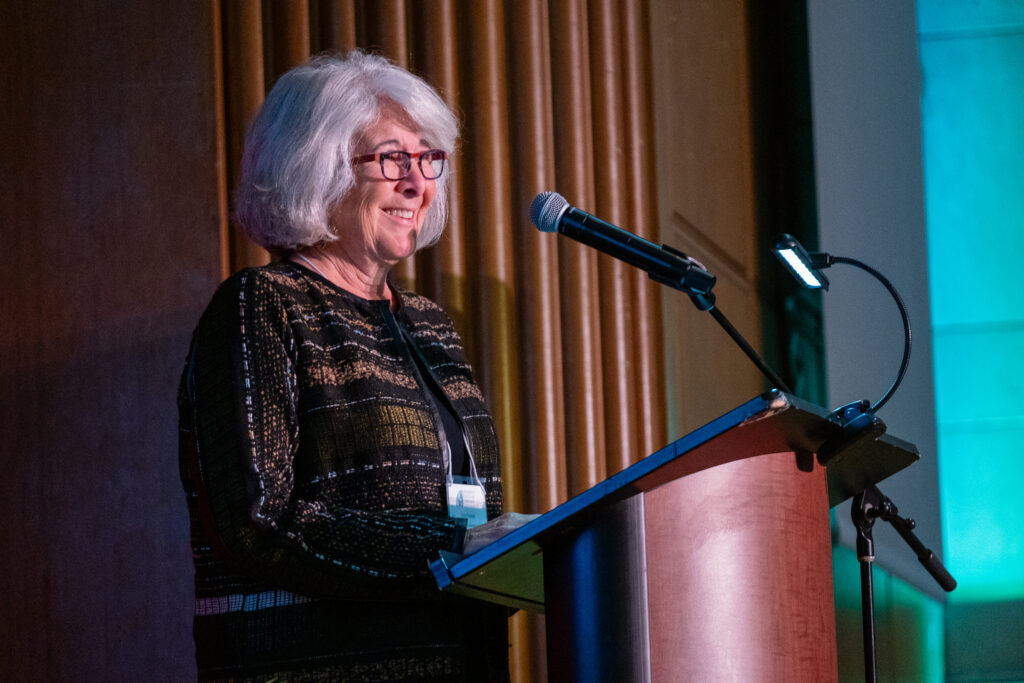
On October 23, 2025, Domini’s Founder and Chair, Amy Domini, received the ICCR Legacy Award alongside Reverend Séamus Finn at the Interfaith Center on Corporate Responsibility’s annual gathering in New York City. The award recognizes individuals whose work has established a lasting foundation for investor action on social and environmental issues. The presentation included introductory remarks from Steve Lydenberg, who recently retired from Domini and has been a central partner in shaping the field of responsible investing.
Below is the full transcript of Steve’s introduction and Amy’s acceptance remarks.
ICCR Legacy Award Presentation – October 23, 2025
Rob Fohr, ICCR Vice President for Strategic Alignment
I would like to welcome Steve Lydenberg to present the 2025 Legacy Award to Amy Domini. Steve is a pioneer in his own right in our field as Partner, Strategic Vision for Domini Impact Investments, Founder and Chairman of The Investment Integration Project, and Founding Director of the Initiative for Responsible Investment. For four decades he has been active in responsible investment with the Council on Economic Priorities, Trillium Asset Management, and KLD Research and Analytics.
Steve Lydenberg
I’ve worked with Amy for 35 years. I have known her for 40 years and I have known of her for 45 years. One of the advantages of growing old is that you know people for a long time. You know who they are, you know what they have been, and you know the mark that they have left on the world, and you know when the world will inherit something exceptional from them.
The knowledge, the wisdom, the ways of thinking that they have delegated to us, passed on to us—you know who has left a legacy that will last. And Amy Domini is one of those exceptional people who through a lifetime of work has left a true legacy that will truly last.
Year in and year out from the 1970s and the 1980s on, she was everywhere promoting the idea of responsibility in investment, of ethics in investment, of social and environmental standards in investment.
I joined the company that she founded in 1990 that would create the first social and environmental index fund. For 10 years there were no imitators of this truly revolutionary idea. Now there are literally thousands of variations on that theme.
It was also the company that would be the first to provide comprehensive overviews of the social and environmental records of the companies in the S&P 500 index. Now the largest companies around the world voluntarily report that information and that is everywhere.
In the 1990s I followed Amy around to learn from her as she promoted these themes to a financial community that greeted them with skepticism at best or with outright dismissal. I remember the word we got back once from our inquiry to a very large and well-known financial services company as to whether they might be interested in launching a fund based on the Domini Social Index. We were told, “The CEO says this company will never have anything to do with socially responsible investment.” It took them a good 25 years to change their mind.
I learned from her who the players were in this small world but growing world and a good number of them were members of ICCR. That was the beginning of her long and deep relationship with ICCR and her appreciation for its works and for the leadership ICCR was providing for those advocating social responsibility, first under Tim’s leadership and now with the baton passed on to Josh Zinner.
I came to understand her vision of what work in this field means. She was a storyteller who knew how to communicate the essence of what she was about. The starfish girl who understood the importance of making a difference even if it was only for the one. Cowboy Bob who was reining in the runaway horses of finance. A need to know who you are and what you are and to do the right things. These are all part of the legacy that she has left for us. These messages that she has conveyed through the institution she has built and through the stories that she has told.
I want to express my personal gratitude to her for the clarity of her vision of what it takes to bring about change in this world, for conveying the messages that I and many others have learned from her. The path to tomorrow is clearer today because of her tireless work over the years. We are all the better for it and the journey forward will be easier because of it.
And for these reasons I am honored to present the ICCR Legacy Award, the text of which reads in part, “Let it be resolved that the shareholders of all publicly held US corporations acknowledge the countless contributions of Amy Domini to promoting more just and sustainable corporations.”
She has paved the way for values-aligned investment long before it became mainstream. Amy’s work fundamentally changed the conversation that excluded poorly performing companies from portfolios to thoughtfully evaluating companies based on an array of environmental and social metrics. Amy, I hereby present to you this legacy award from ICCR.
Amy Domini
Thank you all. It’s a real pleasure to be here. And thank you, Steve.
I think maybe I’d like to start, gentle audience, with a quote from 1983, 42 years ago taken from an opinion piece published in the New York Times. And the quote is, “The regulations represent a clear departure from the SEC’s position in recent years of general support for shareholder access to the proxy.” The author of that piece was Steven Lydenberg, my amazing partner for 40 years. Already in 1983, taking every opportunity to call attention to preserving each and every tool in our toolbox for corporate social responsibility.
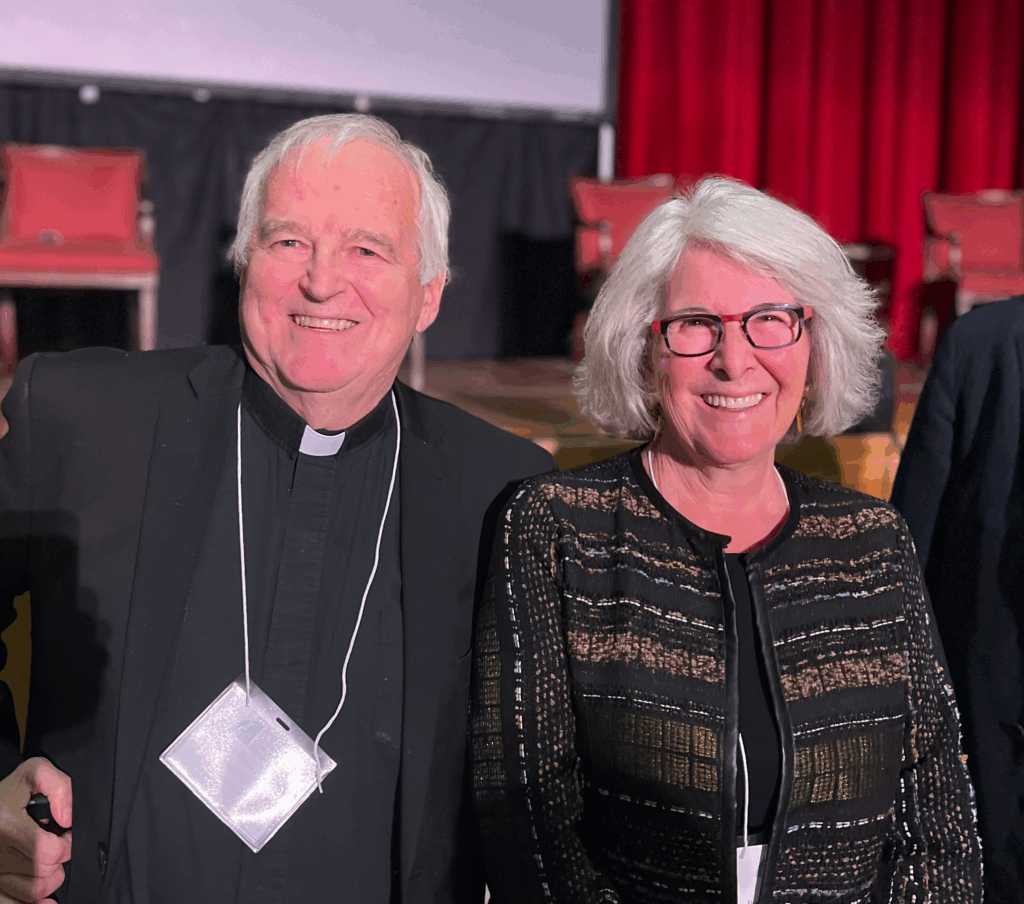
And, if I may, I’d like to thank Seamus Finn. This man who hardly knew me, who was willing to be here repeatedly and to organize a responsible investing conference in Boston, I don’t know how long ago, but it was long enough ago that it involved two long deceased icons in our field: Joan Bavaria was our keynote speaker and sister Regina Rowan thrilled our audience with her tale of eliciting $100 million a year, street value, worth of Ivermectin to prevent river blindness, which won her a reserved front-row-seat at the annual meeting each year at Merck Corporation, so that she could rise and ask for the commitment again next year. Thank you, Seamus.
And you gentle audience, here are so many faces, people who do it, who make it happen, who give voice to the voiceless and hope to the defeated. So many of you, and so many lessons you have taught me.
My own journey with ICCR began in 1987. The ceaselessly committed Tim Smith made it happen. He was consulting with the Episcopal Church Committee on Corporate Social Responsibility and mentioned that I existed and had written a book called Ethical Investing and was an Episcopalian. With those words he opened a vast new landscape to me. I was soon serving with the venerable Father Brian Grieves and attorney Paul Neuhauser on the committee and with Paul at the ICCR meetings. The next thing I knew I was standing up at a Digital Equipment Corporation meeting and asking the company to leave South Africa, shaking like a leaf.
Almost 20 years ago I spoke here, I told a story of my father, a teenager in the four days of Naples, given shelter in a crypt at a convent, sliding the lid off in the morning and crawling into the light, to find the nuns had all been hung by Nazis during the night. Yes. It can go that far wrong. And only people standing up to evil can stop madness. I grew up knowing that.
But what I do want to be certain, you will realize here at ICCR, is what I learned from you. I learned that in each corner of this world, there is a faith community doing some kind of work. When a random Oblate mission sees a problem with worker conditions in Haiti, when a Sister of Mercy sees unsafe sanitation in a village halfway around the world caused by corporate pollution, their brothers and sisters have a treasury. That treasury has someone who knows of ICCR, knows the work we do, and raises the issues of injustice being enabled by an understandable human desire for material goods. Someone from an investment firm in the room is also disgusted and owns shares of the company. Someone else in the room knows something about assessing, assessing how these conditions link to the corporate bottom line, the web tightens, the campaign launches, and it may start out in Haiti with baseballs, but soon it’s an international campaign on what we, at the time, were calling sweatshops, now supply chains.
The story is repeated with many issues. Suddenly we learn children are playing violent video games, the rights of citizens in Northern Ireland are unequally distributed, suddenly we recognize the need for clean drinking water not shipped in gas guzzling trucks, carrying dangerous plastic encasing the treasure. In each case, it was (and perhaps I should apologize for the metaphor) boots on the ground that the Faith Coalition brought together.
And here we are today, one of the many, doing what we can to protect majority of humankind from the inhumane capacity of the few. ICCR, with hundreds of successful campaigns to our credit, a record no other can claim, continues the work. I want to underscore that: A record no other can claim. You in this room, and those who once stood here, have moved the needle on fair wages for tomato pickers, on restrooms for people who work ten hour days in a shack, on children sewing soccer balls with a chain on their ankles, on Indigenous lands being protected for their rightful owners, on the right to vote in a land your people have lived for millennia, on how to grow flowers that don’t kill pollinators, on distribution of needed medicines to the least of us, on the need to hold corporate leaders to a higher standard of accountability. And you continue the work, uncowed by the current circumstances.

Moving through the years has some downsides, but one upside is a whole lot of issues you get to see turn out. What mattered? You, this federation mattered. You, ICCR, uniquely have done this. Would corporations have gotten this done without ICCR? Would we even have had the tools? No, of course not.
This Interfaith Center on Corporate Responsibility, this is who we are. We are over 360 member organizations. A wild guess is that each of these organizations also donates the equivalent of 250 full-time employees paid to seek justice for those left behind by the miracle of capitalism. Fighting for a sustainable ecosystem for universal human dignity, for accountability from those in power. You, who are also donors, we thank you. You are helping to finance an organization that filed about 400 resolutions last year. Over 250 of these were climate resolutions facing the existential question of the century. Can human beings survive human activity? People and the planet. I thank you.
Tim Smith, you deserve another call out. You had a vision. You have worked your entire life to build and sustain a framework for shareholders with morals to take action. I stand in awe and would be remiss not to acknowledge your years of service on my own enterprises too.
Josh Zinner, you have stepped into a quagmire of opinionated people with clashing approaches and you’ve stepped in with dignity and patience and brought us to a new stage of activism. Your background as a trial lawyer was only the beginning of a lifetime of changemaking. Your willingness to stand up to the overreach of the powerful is stunning and it is what the world happens to need right now.
And kind friends, whether intimate or unmet, I thank each of you for the work you’ve done, for the work you continue to do, for your faith in each other and in the human experience, for your love of this green planet and all the creatures here on. We are a communion. We are the Interfaith Center on Corporate Responsibility. This is our meeting hall. I know that I treasure this organization and I know that each of you do as well. The fight continues, but then we always knew it would.
Thank you for remembering me tonight. Thank you and God bless.