

By Lionella Pezza, Director of Impact Research. Originally published in GreenMoney Journal (September 2026).

Director of Impact Research
Since the early 1990s, Domini Impact Investments has anchored its investment philosophy in two principles: environmental sustainability and universal human dignity. Those priorities have not changed. However, we have continuously refined and fine-tuned how we pursue our goals.
Our approach to energy investing tells that story clearly. It mirrors the broader evolution of sustainable investing: from identifying and avoiding harm to actively investing in the systems that will define a low-carbon economy and sustainable energy.
From the outset, Domini did not have a blanket ban on energy companies. Instead, firms were evaluated against environmental and social standards. In practice, few large oil and gas companies qualified. Most fell short on issues such as environmental stewardship, worker safety, and community impact.
One early example was BP. Domini excluded the company in 2005, citing persistent safety failures and a pattern of environmental violations. In 2010, BP’s Deepwater Horizon explosion caused what is widely considered the largest marine oil spill in the history of the petroleum industry, estimated to be between 8% and 31% larger than the previous worst spill. The disaster underscored what our research had already suggested: weak safety and governance practices can translate into severe environmental and financial consequences.
As climate science advanced and the risks associated with fossil fuel dependence became more explicit, Domini’s approach evolved.
In 2015, we adopted a policy restricting investment in oil and gas exploration and production companies. This marked a shift from case-by-case assessment to a broader recognition that fossil fuel extraction itself posed systemic risks incompatible with long-term sustainability.
That shift continued. In 2018, all Domini funds became fossil-fuel free through the exclusion of the entire Global Industry Classification Standard (GICS) Energy Sector. This expanded the scope beyond exploration and production to include refining, storage, transportation, equipment, and services. The same year, we launched a system-level investing initiative, including deeper work on forests and other critical climate challenges.
We evaluate utilities through a similar lens: we seek to avoid companies whose generation capacity is heavily dependent on coal and exclude those that have announced or begun building new coal-fired plants after the adoption of the Paris Agreement.
While these decisions matter, exclusions are only a starting point. Avoiding harm reduces risk, but building a sustainable economy requires investing in the companies and systems that enable change. Today, Domini’s research increasingly focuses on those systems. The transition to a low-carbon economy and sustainable energy is not driven by any single sector. Renewable energy generation is essential, but it depends on a network of technologies, infrastructure, and capital flows that make scale possible.
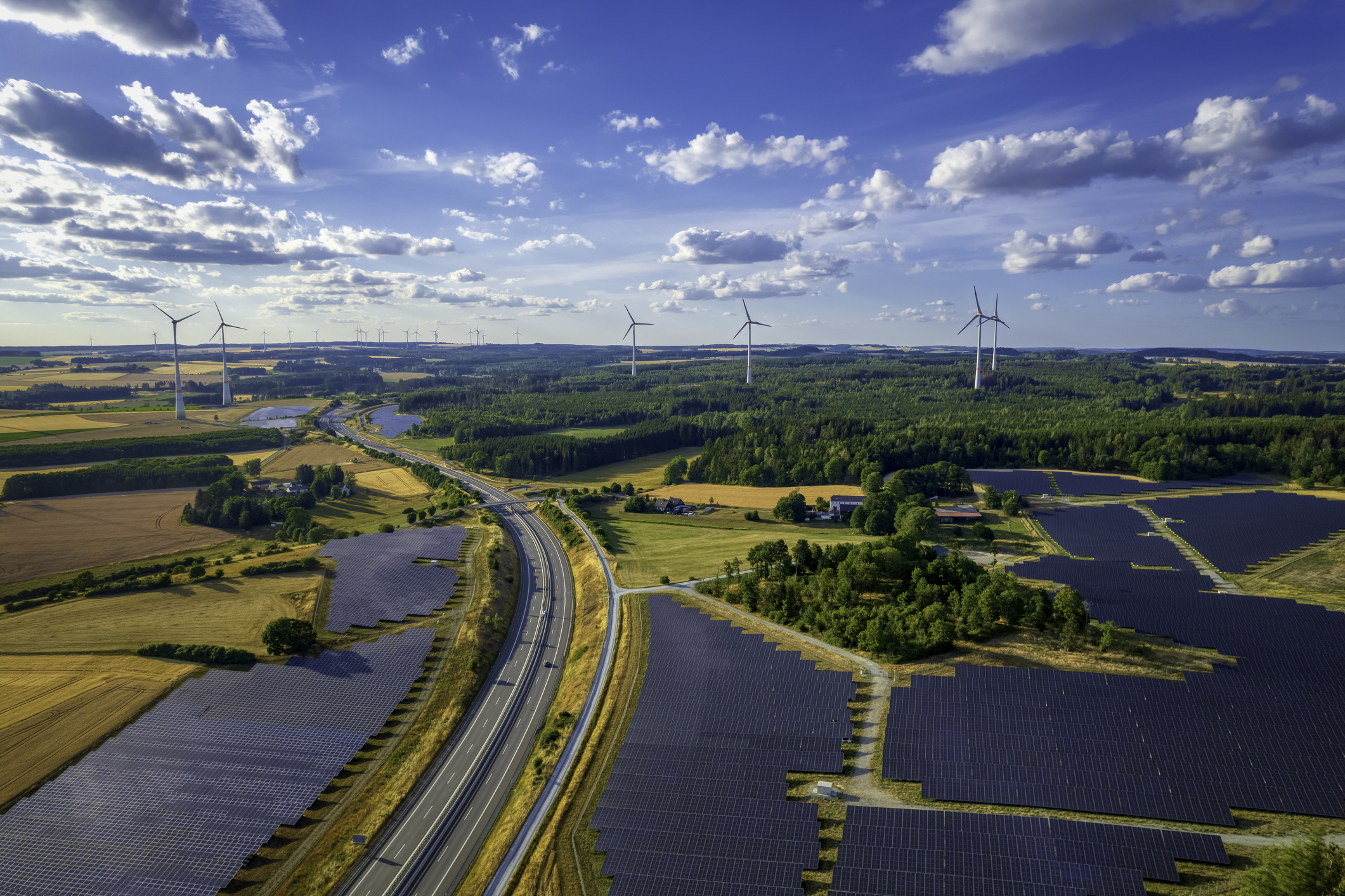
Consider wind energy. Domini invests in Vestas Wind Systems, a global leader that has helped expand renewable power generation worldwide. In its latest fiscal year, Vestas’ Power Solutions segment accounted for roughly 80% of revenue, covering the design, manufacturing, and installation of onshore and offshore wind turbines. As the market leader in onshore wind, the company sits at the center of one of the most important growth areas in the energy transition.
But generating renewable electricity is only part of the equation. An electrified, low-carbon economy depends on technologies that are less visible but equally indispensable.
Semiconductors are one such example. Modern energy systems, from wind turbines and solar installations to smart grids, storage, and efficiency technologies, rely on increasingly advanced electronic components. Without them, scaling renewable energy would not be feasible.
This is one reason Domini invests in Monolithic Power Systems. The company designs high-performance power-management semiconductors that make electronic systems smaller, more efficient, and less wasteful. Its chips are used across renewable energy infrastructure — from solar power to wind turbines to battery storage — where they help convert and control electricity with minimal loss. In solar arrays, for example, they increase power output by reducing switching losses and optimizing efficiency, turning more sunlight into usable energy. These are the unseen components that make decarbonization work.
Technology alone, however, cannot deliver the transition. Capital is equally critical.
Building renewable energy infrastructure, modernizing grids, and scaling clean transportation require significant and sustained investment. Financial institutions therefore, play a central role in determining how quickly and how effectively the transition unfolds.
Domini’s investment in DNB reflects this perspective. As Norway’s largest financial services group, DNB has committed to financing and facilitating NOK 1.5 trillion (roughly $157 billion) for the sustainable transition by 2030, with renewable energy and infrastructure among its priority areas. DNB supports the low-carbon transition in multiple ways. It lends to customers developing both onshore and offshore wind power projects and, beyond debt financing, helps those customers raise equity, moving capital into large-scale renewable developments. Through its asset management arm, it also offers a dedicated renewable energy fund to both retail and institutional investors, expanding access to transition-related investment opportunities.
This kind of capital allocation is not peripheral; it is decisive. Renewable projects do not move forward without financing, and institutions that prioritize sustainable investments can accelerate deployment at scale.
Taken together, these examples illustrate how Domini’s approach has broadened. The shift is not simply that our fossil fuel screen widened over time, from including select fossil fuel companies to excluding the entire sector, but from sector-based thinking to system-level analysis.
Clean electricity depends on grid infrastructure and efficiency technologies. Wind turbines and solar panels depend on semiconductors. All of these projects depend on financing. Each piece is interconnected, and each represents a potential investment opportunity.
This perspective also reflects a more nuanced understanding of risk. Climate risk is not confined to fossil fuel producers. It extends across supply chains, infrastructure, and capital markets. Conversely, the opportunities associated with the transition are equally distributed across sectors that may not traditionally be labeled “energy.”
For Domini, this means looking beyond conventional classifications and asking a more fundamental question: which companies are enabling a resilient, low-carbon economy based on sustainable energy?
The answer often lies in places that receive less attention. It includes manufacturers of critical components, providers of enabling technologies, and financial institutions that direct capital toward sustainable outcomes.
This is where sustainable investing becomes more demanding and more consequential. Exclusions are relatively straightforward to implement. System-level investing requires deeper analysis, a broader scope, and a willingness to look across traditional boundaries.
It also aligns more closely with our mission. Advancing environmental sustainability and human dignity is about supporting the structures that make a different kind of economy possible.
Investing in a cleaner future means investing in the foundations of tomorrow’s economy and in the companies helping to build it.