

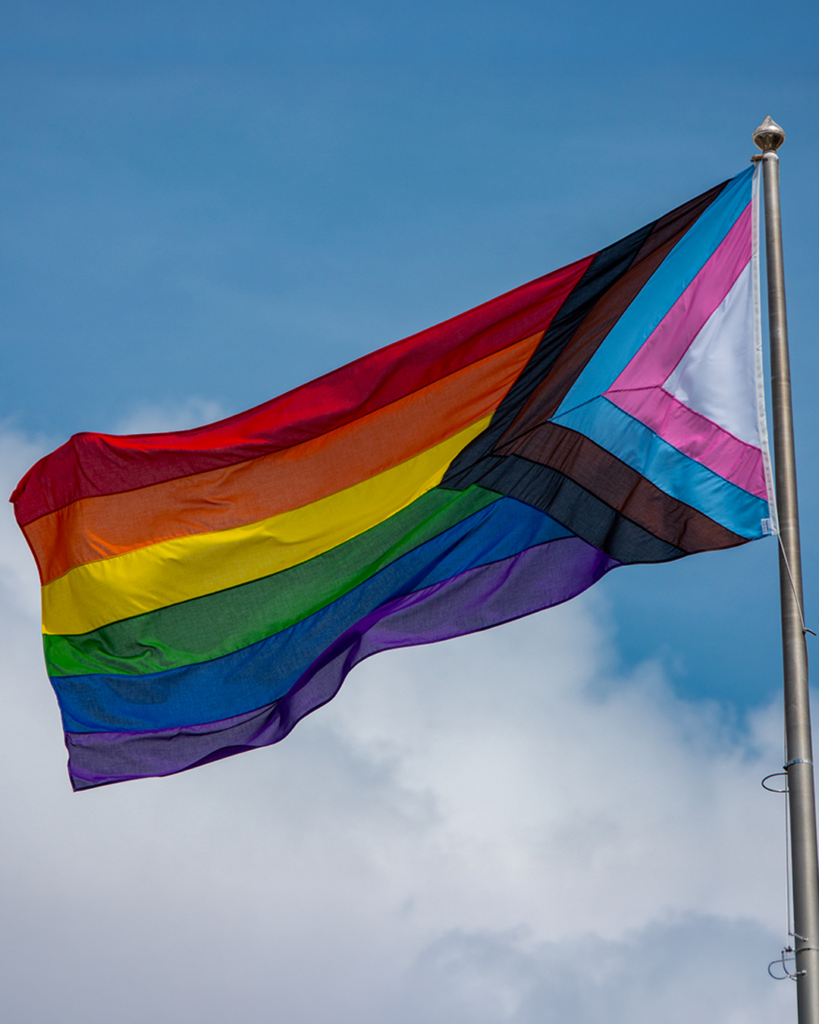
Why does Pride matter to impact investors? Because human dignity matters, and because the long-
term health of our economy is inseparable from the fair and full participation of every person in it.
Pride begins with a simple truth: no one should have to make themselves smaller, quieter, or invisible
to be safe. No one should have to leave part of who they are at the door of their workplace, or weigh
whether honesty about their own life might cost them a job, a promotion, or a sense of belonging. The
right to live openly and free from discrimination is a question of human dignity. And at Domini, the
advancement of universal human dignity is one of the fundamental goals of our Impact Investment
Standards.
When we say that we invest for the dignity of every person, we mean every person. Pride is a
celebration of lives lived openly and a recommitment to the idea that everyone deserves to belong.
The rights, safety, and full participation of lesbian, gay, bisexual, transgender, and queer people are
inseparable from the goal of universal human dignity. As that idea is tested in public, the case for
standing firm is not only moral. It is also factual, economic, and squarely in the long-term interest of
the companies we own and the investors we serve.
Progress under pressure
LGBTQ+ people have always been part of every community, every workforce, and every market, and
today more of us are able to say so openly than at any point in history. In its most recent estimate,
Gallup found that 9% of U.S. adults identify as lesbian, gay, bisexual, transgender, or otherwise
LGBTQ+, more than double the 3.5% it first measured in 2012. Among adults under 30, the figure rises
to 23%. That visibility did not happen by accident. It is the product of decades of hard-won gains in
rights and protections, from workplace non-discrimination to marriage equality, that made it safer to
live openly.
Even with that progress, the day-to-day reality for many remains difficult. In a 2023 survey by the
Williams Institute at UCLA School of Law, nearly half of LGBTQ employees, 47%, reported experiencing
discrimination or harassment at work because of their sexual orientation or gender identity at some
point in their lives. Roughly one in five said they had been fired or had not been hired or promoted for
the same reason. Perhaps most telling, 46% said they were not open about who they are to their own
supervisor, meaning that nearly half of LGBTQ workers spend their days editing their own stories,
dodging questions, and carrying a vigilance their colleagues never even have to think about. It is an exhausting way to work and can quietly drain trust, retention, and the energy people bring to their jobs. The only way to change this is to continue building a culture of belonging—one where inclusive policies and everyday respect make people feel safe and welcome to bring their whole selves to their jobs and communities.
Unfortunately, an extraordinary volume of new anti-LGBTQ legislation introduced across the U.S. threatens to do the opposite, putting years of progress at risk. As of mid-2026, the American Civil Liberties Union was tracking 530 anti-LGBTQ bills in state legislatures, part of what it describes as a record wave of state-level attacks that has escalated dramatically over the past decade. The Trans Legislation Tracker, which focuses specifically on measures that would negatively impact transgender and gender non-conforming people, is following 793 such bills that have been introduced across the country. These measures—which span healthcare, education, legal recognition, and more—seek to narrow the space in which LGBTQ people can fully participate in public life.
This legislative pressure is unfolding alongside a softening in public attitudes. After two decades of steadily rising support, Gallup’s 2026 Values and Beliefs survey found that backing for legal same-sex marriage has slipped to 65%, down six points from its 2022 to 2023 peak, while the share of Americans who view gay or lesbian relations as morally acceptable, 62%, is the lowest since 2016. Most Americans still support these rights, but the reversal is a reminder that progress is not self-sustaining. It is precisely in moments like this that the steady, public commitment of employers and investors matters most, helping to hold open the space for people to live and work as themselves.
The challenge for companies
These legal headwinds are reshaping how companies think about, and carry out, their workplace inclusion strategies. A growing body of state and federal action, much of it aimed at federal contractors, is now being interpreted to directly constrain corporate diversity, equity, and inclusion efforts—the very programs through which many companies have advanced non-discrimination and workplace belonging. A federal executive order issued in early 2025, reinforced by a follow-on order in 2026, directs the government to scrutinize the DEI practices of private employers and requires federal contractors to certify that they do not operate discriminatory DEI programs, or they risk losing their contracts. At the state level, Texas Senate Bill 17 banned DEI offices, mandatory diversity training, and diversity statements at public universities, and numerous other states, including Florida, Alabama, and Tennessee, have passed similar restrictions.
Faced with legal uncertainty and the threat of lost contracts, some companies have grown cautious about programs they once championed. Research firm Gravity Research found that 39% of corporate executives planned to scale back Pride engagement in 2025, up sharply from the year before. That caution has carried into 2026: Pittsburgh Pride expects only 30 to 40% of the sponsorship it once secured, and Tampa Pride announced a one-year pause after sponsors withdrew.
But there are encouraging signs. New research from Catalyst and NYU Law’s Meltzer Center, drawn from a survey of more than 2,000 employees and leaders, found that while 55% of organizations publicly signaled a retreat from DEI, only 34% actually decreased their inclusion efforts, while 80% of organizations remain committed to workplace inclusion. The pressure is also not evenly felt: while 51% of federal contractors have scaled back under regulatory scrutiny, the majority of companies that are not federal contractors have actually increased their efforts. As Catalyst put it, this is a story of adaptation, not a broad rollback. Public visibility is following suit, with signs of corporate support for Pride making a quiet, cautious comeback. Companies from Mastercard to American Eagle have boosted their contributions this year, even as overall support remains below the highs of the early 2020s.
For investors, this moment is clarifying. It brings into focus the companies whose commitment to inclusion is woven into their strategy and identity, sustained not because it is easy but because they understand the opportunities it creates. These are businesses that recognize a diverse, supported workforce as a source of talent, trust, and innovation, and that see fairness toward employees and customers as inseparable from sustainable value creation. Steadiness of this kind, held through changing winds, is itself a signal of management quality and the surest foundation for the lasting trust on which long-term value is built.
Levi Strauss & Co. offers a vivid example of what that steadiness looks like. The company has treated LGBTQ support as, in its own words, “a legacy, not a campaign.” It became the first Fortune 500 employer to offer domestic partner benefits to same-sex couples in 1992, and has earned a perfect score on the Human Rights Campaign’s Corporate Equality Index for 22 consecutive years. In 2026, even as others have stepped back, Levi’s has deepened its commitment with a $100,000 donation to Outright International, additional grants to The Trevor Project and the Human Rights Campaign, and visible sponsorship of Pride in San Francisco, Amsterdam, Mexico City, Paris, and Warsaw, calling these all “expressions of the same conviction we have held for decades.” That kind of resolve is exactly what long-term shareholders should want to see.
The business case has not changed
The strategic logic for inclusion is, if anything, stronger than ever. The global research initiative Open for Business has linked LGBTQ inclusion to stronger performance across dozens of indicators—inclusive companies compete more effectively for talent, retain employees longer, generate more innovation, and earn deeper loyalty from the values-driven consumers who increasingly drive growth. That logic is increasingly borne out in the financial data. Whistle Stop Capital and the Human Rights Campaign Foundation analyzed 15 years of corporate data and found that companies with stronger LGBTQ-inclusive policies, as measured by the Corporate Equality Index, delivered increasingly strong financial results the longer those policies were in place. Over a 10-year period, top-scoring companies reported average net income more than eight times higher than their lowest-scoring peers, alongside stronger revenue growth, greater gross profit, and more stable share prices—a pattern the researchers read as a sign of consistent, long-term investor confidence.
Those returns rest on a market that is itself substantial. The National LGBT Chamber of Commerce estimates that LGBTQ consumers in the United States hold nearly a trillion dollars in annual spending power and that LGBTQ-owned businesses contribute $1.7 trillion to the national economy each year. Companies that alienate these consumers and business partners, or the far larger share who simply expect them to be treated with fairness, are not managing risk. They are creating it. Inclusion is a source of the durable advantage that patient capital depends on.
The path forward
Domini has always believed that the purpose of the economy is to serve people and the planet, and that universal human dignity is essential. For companies, there is real value in staying the course. Maintaining non-discrimination protections, inclusive benefits, diverse leadership, and a workplace where employees do not have to hide who they are should not be treated as a passing trend. These are fundamental commitments and the foundations of a healthy, high-performing organization. The companies that hold to their values under pressure are the ones best positioned to earn lasting trust. For investors, inclusion is a long-term value driver, and treating it as one is simply good stewardship. The capital we allocate carries our values into the world, and directing it toward companies that respect the dignity of every person is an expression of that responsibility.
Engagement remains one of the most meaningful ways investors can encourage the businesses they own to keep their commitments. When fewer voices are willing to speak, the ones that remain matter more, not less.
Despite current headwinds, there is reason for optimism. Progress has never moved in a straight line, but the long-term direction is unmistakable: toward more people living openly, more families recognized, more young people growing up free to be exactly who they are. A generation is coming of age that expects to be treated with dignity and expects the companies it works for and buys from to deliver it. The businesses and investors who embrace this are building lasting, sustainable value.
Supporting and defending LGBTQ rights is not a departure from sound investing. It is sound investing, and it also happens to be the right thing to do. In this moment, we are proud to stand with all of the LGBTQ members of the Domini community.