


Impact Update
Second Quarter 2026
Turning Commitments into Practice
The past decade produced a remarkable volume of corporate sustainability pledges: net-zero targets, deforestation-free supply chain commitments, human rights policies, and financing for underserved communities. Setting those goals took real effort. Meeting them will take more.
This quarter, that shift played out across our engagement work and portfolios. Rising expectations from regulators, communities, workers, and shareholders are testing corporate commitments on climate, deforestation, human rights, and financial inclusion. Some companies are meeting the moment; others are finding that a public pledge is easier to make than to keep.
At Domini, we believe the credibility of a sustainable business model depends on evidence that commitments translate into practice. This edition looks at where that translation is working, where it is stalling, and how investor leverage can help move it forward.
Second Quarter Engagement Overview
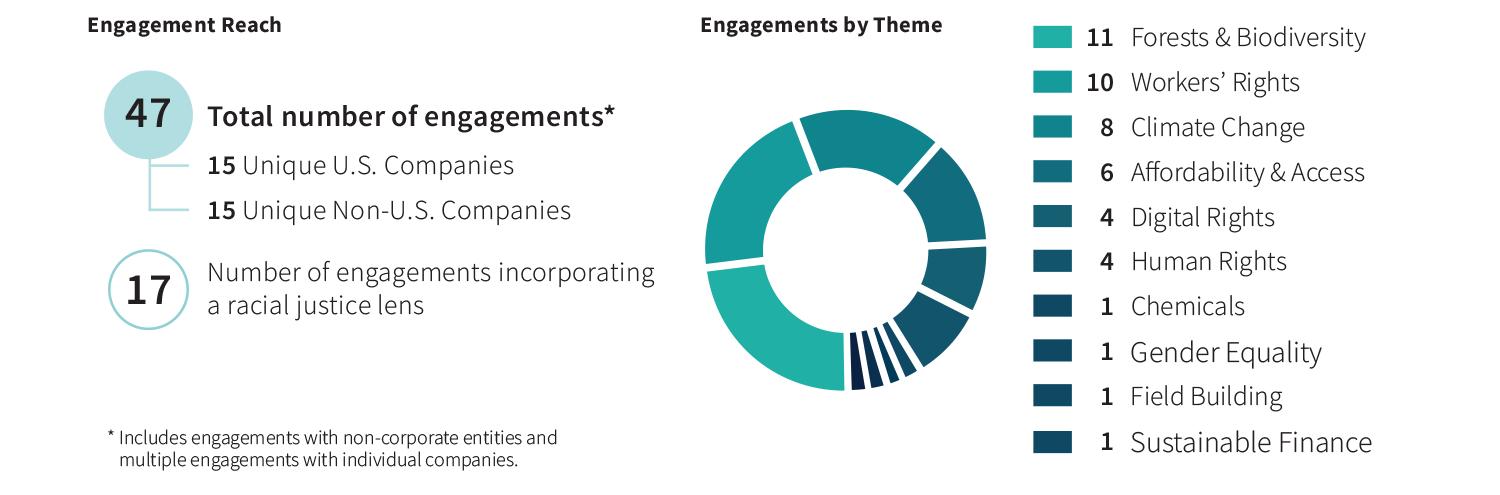
We meet with company executives to encourage stronger policies and practices on issues that advance sustainability and long-term business success. Guided by our Impact Investment Standards, we seek enhanced disclosures, more responsible business practices, and progress on emerging issues. Through constructive dialogue, shareholder proposals, and proxy voting, we communicate our expectations to companies and promote universal values of fairness, equality, justice, and respect for human rights, while contributing to ecological sustainability and climate resilience. We do this work seeking positive impacts for people, planet, and profit. Read more at domini.com/engagement
Collaboration in Action: Participation at Annual Shareholder Meetings

Some of the most important shareholder work happens at annual general meetings (AGMs), where investors vote on governance matters and can question executives and board members directly. At their best, AGMs create a forum for direct exchange between companies and their key stakeholders. But as more companies move to virtual formats, that opportunity is shrinking, and corporations are showing more caution around hearing critical views.
We believe workers and community advocates often have the most accurate, on-the-ground understanding of corporate impacts, and it matters that they can bring evidence and lived experience into these meetings. This quarter, we used our shareholder rights to provide proxies to allied advocates so they could attend AGMs in person.
Chubb: Chubb Limited is one of the largest property and casualty insurers globally, and its underwriting decisions carry significant weight in whether high-impact fossil fuel infrastructure gets financed and built. We have engaged Chubb for years on the human rights and biodiversity risks of its fossil fuel underwriting, and this May, we provided proxies to representatives working with Gulf Coast communities to attend its AGM in Zurich.
The delegation asked the board two core questions: (1) how it is managing systemic risk from its continued underwriting of liquefied natural gas (LNG) projects and broader fossil fuel exposure, particularly as geopolitical conflicts reshape energy markets; and (2) how it manages human rights and biodiversity risks associated with LNG expansion in the Gulf Coast region. The advocates noted that a formal human rights complaint had been filed against other insurers of a Gulf Coast LNG exporter over impacts on Gulf Coast fishing communities. Chubb’s Chairman and CEO responded by pointing to the company’s tested risk models and the importance of insurance to energy security. The delegation urged Chubb to align its due diligence with the UN Guiding Principles on Business and Human Rights and delivered a letter from an affected community seeking further dialogue.
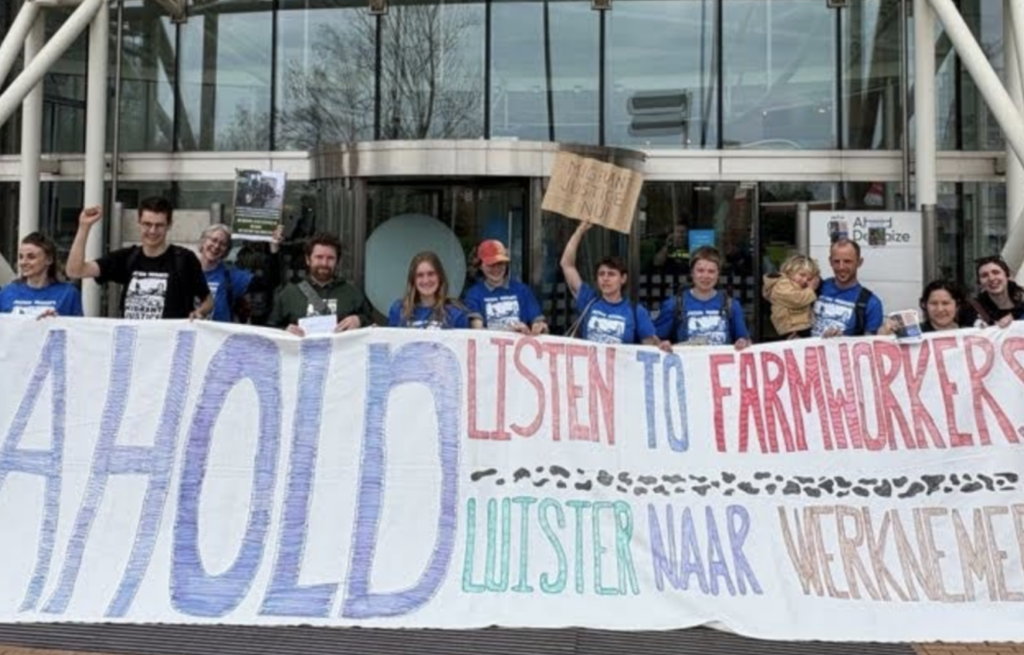
Ahold Delhaize: Migrant Justice, a Vermont-based farmworker organization, has campaigned for years to bring Hannaford—a subsidiary of Koninklijke Ahold Delhaize N.V. and one of the Northeast’s largest dairy buyers—into the Milk with Dignity Program, a worker-driven social responsibility model already used by Ben & Jerry’s. For the second consecutive year, we provided our proxy, alongside United Church Funds, for Migrant Justice representatives to attend Ahold Delhaize’s April AGM in the Netherlands.
Migrant Justice representatives read farmworker testimony about the severe and widespread human rights abuses on dairy supply farms. They acknowledged the company’s recent Human Rights Impact Assessment, announced at last year’s AGM, and asked about the timeline for sharing findings with the workers who participated. They also raised a formal human rights complaint filed on behalf of dairy farmworkers with the Dutch OECD National Contact Point, which has taken up the case and will provide a neutral forum for mediation. The company has still not committed to joining Milk with Dignity or publishing the assessment results, but it did share some insights on work underway with suppliers and announced that its USA division has joined the Responsible Labor Initiative to strengthen supply chain oversight. After the meeting, the delegation was able to speak with a few company representatives, which we hope moved the conversation forward.
While neither meeting fully delivered what the delegations hoped for, we believe that showing up and being heard is also an outcome. Our role as investors is to use every tool we have—proxies, shareholder proposals, direct dialogue—to ensure affected voices are heard in the rooms where corporate decisions are made.
Investment Highlight: Domini Sustainable Solutions Fund
Munich Reinsurance Company, or Munich Re, is one of the world’s largest reinsurers, headquartered in Germany. In an industry that shapes whether high-impact fossil fuel infrastructure gets financed and built, Munich Re has adopted some of the sector’s more substantive underwriting restrictions on new oil and gas, backed by human rights due diligence integrated into both its underwriting and investment decisions.
Since April 2023, the company no longer insures new oil and gas fields, new midstream oil infrastructure, or new oil-fired power plants, and in early 2026 it became the first major reinsurer to restrict cover for new LNG terminals directly tied to new gas fields—a notable step, though gaps in broader gas coverage remain. Its Climate Ambition 2030, adopted in December 2025, commits to no expansion of the insured oil and gas portfolio and to phasing out thermal coal (re)insurance by 2040 and investments by 2030.
Munich Re is also growing its renewable-energy book: its Green Tech Solutions unit currently insures more than 1,400 clean energy projects across 90 countries, covering roughly 75 GW of capacity, and under its Climate Ambition 2030, it has committed to increasing its “climate tackling investments” by an additional €1.5 billion by 2030, which may include investments in renewables, energy efficiency, electromobility, storage technologies, heat supply, and grids.
Climate Targets Meet Reality: Implementation in a Shifting Policy Environment
Many of the companies held in the Domini Funds’ equity portfolios have made meaningful climate commitments, including adopting science-based targets and publishing climate transition strategies aligned with net-zero by 2050. However, the policy and economic environment in which many of these commitments were made has shifted.
The most meaningful shifts have occurred in the United States, where federal climate policy has been rolled back. Across markets, energy demand has increased with the rise in AI, and the cost of capital has increased along with rising energy costs and delayed renewable energy projects. At Domini, we maintain climate expectations for all companies and have focused our engagements on the integrity of commitments and on how they are being translated into operating plans, capital allocation decisions, and customer outcomes, even in the midst of this changing environment.
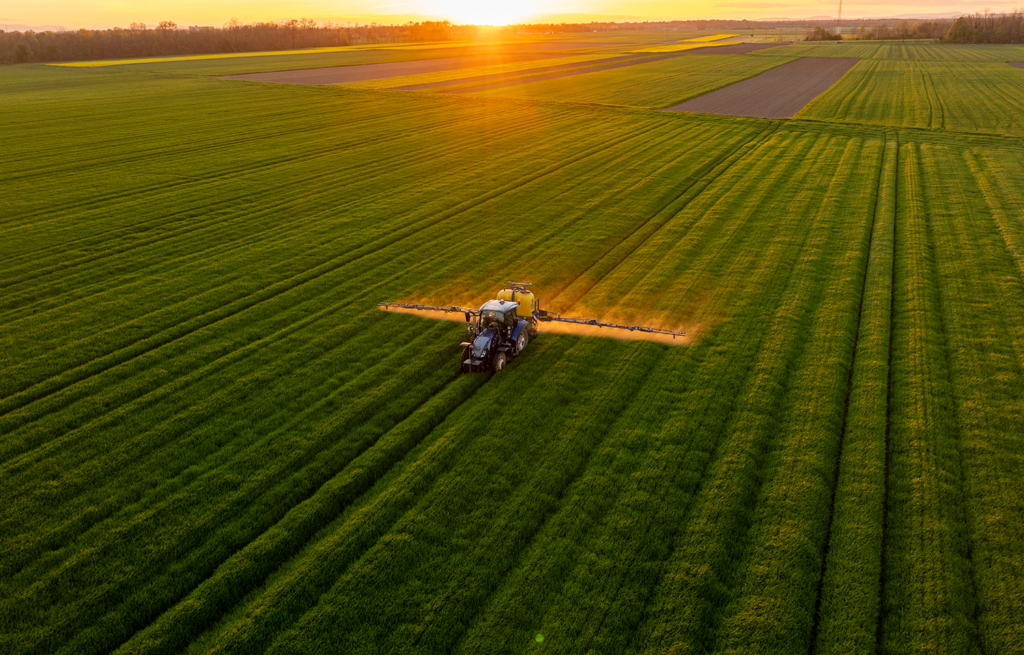
This quarter, we met with two companies at different points in the energy and industrial system. Deere & Company—better known as John Deere, the world’s largest manufacturer of agricultural equipment—published a climate transition plan in 2024 and has set targets validated by the Science Based Targets initiative (SBTi) to reduce Scope 1 and 2 emissions by 50% and Scope 3 emissions by 30% by 2030.
Our dialogue focused on the refinements to Deere’s climate strategy, including the removal of customer-outcome targets in favor of a more general customer engagement aspiration, and the impact of these changes on the company’s overall climate ambition. We questioned whether Deere is on track to meet its 2030 targets given longer timelines around technology readiness and slower customer adoption rates, and whether it will still be able to achieve goals related to engine efficiency, hybridization, battery-electric platforms, and renewable fuels. These metrics are some of the most concrete tools for measuring the impact of Deere’s products on its customers’ emissions, which is the largest driver of its total climate impact.
We also met with Hera Group, an Italian multi-utility that sells gas and electricity, operates gas distribution networks, and provides waste, water, and energy services. Hera has adopted a net-zero target, and we wanted to better understand how it is increasing its provision of renewable energy and making progress to help customers reduce emissions.
Our conversation centered on the challenges of moving customers from gas to renewables or electric in a market where most buildings are connected to gas and national infrastructure was built around the state-owned gas system. Hera was candid about the challenges, including expired electrification incentives and slow uptake of building electrification and electric vehicles. The company is focused on clean gas through hydrogen blending pilots, a partnership to capture carbon dioxide for waste to energy, and energy-efficiency services.
Across both engagements, our message was consistent. We encourage companies to maintain robust climate targets, while acknowledging that targets alone are not sufficient. We continue to push for disclosure of detailed transition plans, quantification of the contribution of each decarbonization lever, and reporting on how capital is being mobilized to support progress on those commitments.
Investment Highlight: Domini Impact Equity Fund & Domini Impact Bond Fund
Apple Inc. has demonstrated climate leadership by setting an ambitious, transparent, and science-based transition strategy. The company transitioned to sourcing 100% renewable electricity for its offices, retail stores, and data centers in 2018 and first achieved carbon neutrality for its corporate operations in 2020, which it achieved again in 2025. Under its Apple 2030 initiative, it has set an even more ambitious goal to achieve carbon neutrality across its entire value chain by 2030, consistent with the Intergovernmental Panel on Climate Change recommendations and a 1.5°C pathway.
A key part of this ambition is to reduce greenhouse gas emissions across its value chain by 75% from a 2015 baseline. So far, according to its 2026 Environmental Progress Report, Apple has achieved a 60% reduction, driven in large part by efforts to transition its supply chain to renewable electricity. In 2025, direct suppliers generated more than 38 million megawatt-hours of renewable electricity, avoiding more than 26 million metric tons of greenhouse gas emissions.
Apple’s Supplier Code of Conduct requires its entire direct manufacturing supply chain to move to 100% renewable electricity for Apple production by 2030, and its Supplier Clean Energy Program supports this transition through policy advocacy, information and access to renewable energy procurement options, and engagement opportunities with renewable energy experts. Apple’s 2030 roadmap also includes goals and strategies for reducing the carbon intensity of its products and manufacturing processes. In 2025, 30% of materials in its products came from recycled or renewable sources, including 100% recycled cobalt in Apple-designed batteries, 100% recycled gold plating and tin solder in Apple-designed printed circuit boards, and 100% recycled rare earth elements in all magnets.
Defending Forests: Advocacy for EU Deforestation Regulation


We have long understood that forests are essential to climate stability, biodiversity, and the livelihoods of people who depend on them. Commodity-driven deforestation for food, clothing, and paper products remains a serious long-term risk to the health of our planet and to the resilience of global supply chains. Supporting robust and effective public policy that strengthens due diligence and oversight is a way to address this issue broadly and effectively across our portfolios and the economy.
The European Union Deforestation Regulation (EUDR), adopted in 2023, requires companies selling products derived from certain deforestation-linked commodities (i.e., cattle, cocoa, coffee, palm oil, rubber, soy, and wood) in the EU to trace those commodities to the plot of land where they were produced and confirm that their production has not been linked to deforestation. Following two one-year delays—including a “simplification” process that led to leather products being removed from the scope of the regulation—the EU Commission recently held an open consultation period to gather input on some remaining questions, including those around IT systems and implementation. After this process, the regulation is anticipated to go into effect for large and medium companies in December 2026.
Investors and companies both benefit from a stable, predictable policy environment that creates a level playing field. Companies benefit from the certainty regulation provides, which lets them plan and invest in compliance systems and supply chain transformation. Many companies have invested in traceability systems and supplier engagement to prepare for EUDR implementation but have now faced two years of delays and uncertainty about the scope and timeline.
This quarter, we engaged on the issue from two perspectives. First, we joined a group of 43 investors representing over €5.5 trillion in assets under management in sending a statement to the EU Commission. The statement urges full and effective implementation of the EUDR, without further delay or reopening of the legislative text.
We also sent letters to three companies in commodity-exposed sectors, together with over twenty investors, about their own policy engagements on the EUDR. We asked each company to clarify its position on the regulation, including how it engages with industry associations to align its advocacy with its public sustainability commitments, and to publicly support implementation without further delay or substantive weakening. We have raised concerns where we see inconsistency between a company’s public commitments and the positions advanced by the trade associations it supports, including groups like the American Forest and Paper Association and the European Automobile Manufacturers’ Association, which have advocated for delays and a narrower scope.
Following up on the letter, we participated in a call with Mercedes-Benz Group to better understand its position and its readiness for compliance. Representatives from the company focused on its implementation efforts and described progress on traceability, including farm-level sourcing of Brazilian leather and a focus on natural rubber as its primary material exposure. Despite this, Mercedes-Benz has not yet made an explicit public commitment to support timely implementation of the EUDR or to distance itself from the misaligned positions of the industry associations it supports.
Investment Highlight: Domini Impact International Equity Fund
Sanofi S.A. is a France-based pharmaceutical company that addresses its impact on nature through the biodiversity pillar of its Planet Care program. In 2025, Sanofi conducted a value-chain assessment aligned with the Taskforce on Nature-related Financial Disclosures, finding that its most significant biodiversity impacts arise upstream in the sourcing of raw materials. The company has established deforestation-free targets for key raw materials that may be derived from commodities linked to deforestation and is working to develop a new sustainable sourcing strategy.
It recently finalized an assessment of the links between its raw materials and commodities derived from wood, cattle, palm-oil, and pigs. In prioritizing these commodities, Sanofi explicitly used the scope of the EU Deforestation Regulation, alongside the Science Based Targets Network’s high-impact commodity list, as a screening criterion.
As of 2025, Sanofi has shifted 75% of packaging paper and cardboard to suppliers using international certifications such as FSC (Forest Stewardship Council) or PEFC (Programme for the Endorsement of Forest Certification). To reduce pressure on local ecosystems, it has also implemented site-specific biodiversity management plans at 100% of its highest-priority sites—those near threatened species, protected areas, and other sensitive biodiversity areas—and expects any remaining sites near sensitive areas to have such plans in place by 2030. These plans establish frameworks and guidance for characterizing local biodiversity features, assessing potential impacts of site activities, and setting targets to reduce potential adverse impacts.
Supporting Economic Empowerment and Climate Resilience for Women

The Women’s Livelihood Bond (WLB) Series is a series of gender-lens bonds created by the Impact Investment Exchange (IIX) to empower women and girls in marginalized communities across emerging markets while delivering stable returns to investors. To date, WLB bonds have mobilized approximately $320 million and impacted an estimated 3.5 million lives across Asia and Africa.
The Domini Impact Bond Fund holds Women’s Livelihood Bond 7a (WLB7a) which finances high-impact women-led enterprises across India, Indonesia, the Philippines, and Sri Lanka. We strongly support the mission of these bonds and appreciate the rigor of the issuance framework. We are also mindful that our investment funds lending in markets where borrower over-indebtedness, repayment stress, and aggressive collection practices have caused real harm. Several countries in the WLB7a portfolio are currently navigating localized microfinance distress, which underscores the importance of client protection standards, transparent pricing, fair collection, and access to grievance and remedy for low-income women borrowers.
This quarter, we initiated an engagement with IIX, the lead structurer and portfolio manager for the WLB Series, to better understand how it manages these risks in the WLB7a portfolio. We discussed client protection practices of the underlying SME lenders and microfinance institutions—including controls on collection practices, interest rates, and grievance access for end borrowers—and IIX’s methodology for evaluating portfolio impact, including outcomes for children such as secondary-education enrollment and health and nutrition. IIX shared detailed allocation, impact, and verification reports that can help us and other investors evaluate use of proceeds against intended impact objectives.
Investment Highlight: Domini Impact Bond Fund
Women’s Livelihood Bond 7a (WLB7a) is the first tranche of the seventh Women’s Livelihood Bond issuance, dedicated to empowering women and girls to build economic resilience and advance environmental sustainability in South and Southeast Asia. It financed loans to nine borrowers across India, Indonesia, the Philippines, and Sri Lanka, working in sustainable agriculture, clean energy, water and sanitation, SME lending, and microfinance—with women in underserved communities at the center of each investment.
The primary intended outcomes are to support improved income generation, financial resilience, climate adaptive capacity, and climate mitigation. As of December 2025, approximately 79,000 women had been directly impacted by WLB7a proceeds through loans for micro-entrepreneurs and women-led SMEs, savings and insurance products, agricultural loans, water- and sanitation-linked loans, and clean energy solutions such as solar products and electric vehicles.
Domini Impact Bond Fund: Impact Theme Allocations*
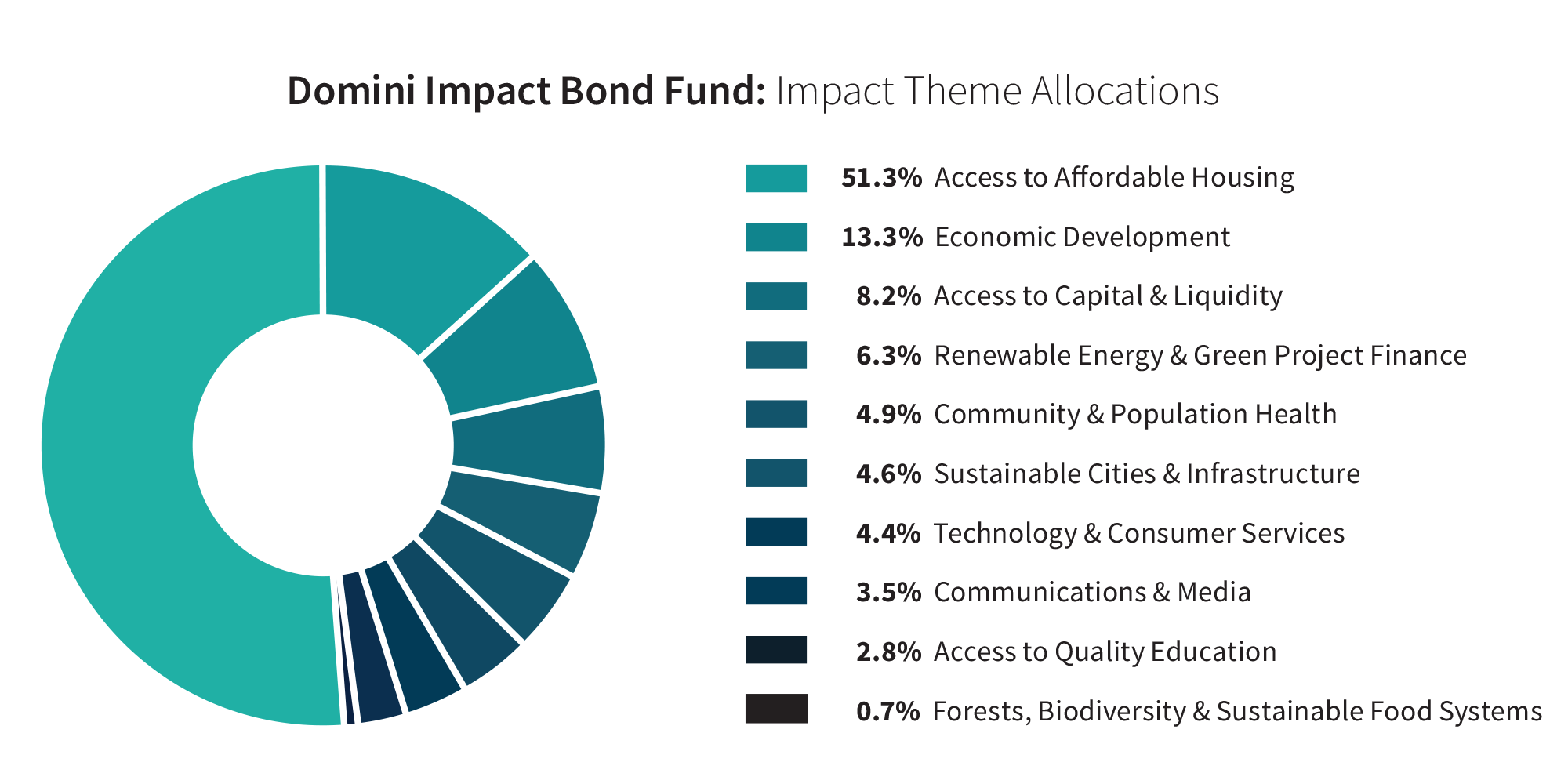
* Based on portfolio holdings as of 6/30/2026, excluding cash & cash equivalents, cash offsets, futures, swaps and options with the exception of short-term U.S. Agency bonds, which are reflected in this reporting. Numbers may not sum to 100% due to rounding. The composition of the Fund’s portfolio is subject to change. Visit domini.com to view a list of the Fund’s holdings.
From Pledge to Practice: Tools for Closing the Say-Do Gap

Over the past decade, companies have produced an extraordinary wave of climate targets, human rights policies, and social impact commitments. Many are still setting those goals for the first time, but for the broader universe, the conversation is shifting from whether goals exist to whether they are being met. Recent research underscores the challenge: the Net Zero Tracker’s 2025 Stocktake found that while 63% of the world’s largest 2,000 companies now have net-zero targets, only 7% meet minimum “starting line” integrity criteria.
This gap between commitment and action—often called the say-do gap—matters to investors. Unimplemented targets undermine the transition-risk assumptions built into portfolio models. Commitments contradicted by a company’s lobbying, capital allocation, or supply chain invite regulatory backlash and reputational harm. And in impact-focused strategies, the credibility of the entire thesis depends on evidence of delivery.
There is no single formula for testing whether a corporate commitment is becoming real, on-the-ground practice, but there are some practical tools that investors can draw on.
Looking for a credible transition plan. A net-zero or biodiversity target is only credible if a company can show the internal systems that will deliver it—interim milestones, capital expenditure plans, executive accountability, and disclosure aligned with frameworks such as the International Sustainability Standards Board (ISSB) and the Taskforce on Nature-related Financial Disclosures (TNFD). We look for transition plans that include emissions targets, governance frameworks, and policy engagements, and that quantify the investments required. Whether a company is actually delivering on those targets is now measurable, and increasingly public. TransitionArc, launched in 2024, covers over 1,000 companies (expanding to 1,500 in 2026) and consolidates leading independent assessments—from the Transition Pathway Initiative, Carbon Tracker, InfluenceMap, the Science Based Targets initiative, Global Canopy, the World Benchmarking Alliance, FAIRR, and others—into a single company profile. Investors can now see whether a company’s stated plan is matched by its emissions trajectory and capital spending. Where those elements are missing, the target is a statement of intent, not a plan.
Testing policy alignment. Even a well-designed plan can be undermined if a company’s indirect advocacy pulls in a different direction. Direct advocacy should match the positions taken by the trade associations a company funds, and this alignment is measurable. InfluenceMap’s 2025 analysis of the 200 largest European companies found that 23% now align their lobbying with EU climate goals—up from just 3% in 2019—but only 12% of the trade associations representing them do the same. Meaningful transparency here means disclosing the trade associations a company funds, regularly reviewing alignment between those associations’ positions and the company’s own, and responding clearly when misalignment persists.
Elevating on-the-ground knowledge. Disclosures and transition plans tell one side of the story; the people closest to a company’s operations often see whether human rights, labor, and community commitments hold up in practice. Affected communities, workers, and the organizations that represent them can understand a company’s operating footprint more clearly than any external analyst. In our engagement work, we turn to worker-driven movements, labor organizers, human rights defenders, and environmental groups to hear from those most exposed to corporate activity. Where credible concerns emerge—about worker safety, Indigenous community consent, or environmental harm—we use our leverage as investors to raise those voices with management and boards. Where appropriate, that includes assigning our shareholder proxy to a community advocate so they can attend an AGM and speak directly with the executives and directors who set corporate strategy.
Tracing bond proceeds to outcomes. The credibility of a labeled bond—green, social, or sustainability—rests on two questions: are capital deployments aligned with the stated use of proceeds, and are they having the intended impact? The ICMA Harmonised Framework for Impact Reporting, updated in June 2026, sets a clear market expectation: annual reporting on use of proceeds and expected impact for the target population or environment. We look for issuers who move beyond activity metrics—dollars deployed, projects funded—to outcome metrics that connect financing to the people or ecosystems it was meant to serve.
No verification tool produces a perfect result, and no reasonable investor should expect one to. What these lenses offer is a way to test whether commitments are being advanced, and to identify the issuers willing to name the gaps between promise and delivery—and to show a plan for closing them. Policy adoption is a first step; the real work happens in implementation.
Domini News

Domini Launches National Impact Investing Day
On June 3, we celebrated the 35th anniversary of the Domini Impact Equity Fund, one of the first sustainable mutual funds, by launching National Impact Investing Day. The annual observance honors more than three decades of progress in impact investing and invites investors everywhere to reflect on how their investment choices support their long-term values and goals.
Recent research from Domini found that nearly eight in ten investors want their money to support a more sustainable world over the next two years, but many are unsure where to begin or what their current investments support. In conjunction with the inaugural National Impact Investing Day, we launched a dedicated resource hub that offers a starting point: five simple questions every investor can ask to look more closely at their portfolio, review the choices behind it, and consider whether those decisions reflect the future they want to help create.
Explore more at domini.com/national-impact-investing-day.

Anniversary Webinar: 35 Years of Investing for Good
As part of our 35th anniversary celebration this June, we hosted a webinar with Domini CEO Carole Laible and Founder Amy Domini. The two reflected on 35 years of impact investing—the challenges and successes along the way—and discussed the path forward for investors seeking to align their investments with people, planet, and profit.
You can watch a replay at domini.com/anniversary-webinar.
Annual Impact Report Now Available!
Each quarter, we publish these Impact Updates to keep Domini Funds’ shareholders, as well as the broader investment community, informed about the ways that we work for change on their behalf. We view this as a key part of our commitment to transparency and an opportunity to demonstrate how investors can have a positive impact. Building on that commitment, we recently published our annual Impact Report, which takes an even deeper dive into how we put the investment dollars of Domini Funds’ shareholders to work for change, from reducing exposure to climate-related risks and protecting biodiversity to championing workers’ rights and supporting equitable access to economic opportunity.
Sustainable Development Goals
In the decade since United Nations member states adopted the 2030 Agenda for Sustainable Development, the Sustainable Development Goals (SDGs) have been widely embraced by governments, civil society organizations, companies, and investors. The SDGs aim to address broad global topics such as poverty eradication, food security, protection of forests, sustainable cities, economic growth, gender equality, and climate change. Engagement highlights in this report are flagged with SDGs they are helping support. Learn more about our support for the goals at domini.com/sdg
