


Impact Update
Third Quarter 2026
Shaping a Responsible AI Economy
Artificial intelligence is rapidly reshaping the global economy, changing how people work, how products are built, and how much energy and water we use. It can also spread misinformation, enable surveillance, and concentrate power, while the most powerful systems are advancing faster than the safeguards meant to govern them. Choices made now about how AI is developed, deployed, and powered will help determine whether it strengthens or undermines human rights, democratic institutions, and a healthy planet.
Many of these choices rest with governments, whose laws and oversight are essential to protect people from AI’s harms and ensure its benefits are broadly shared. Companies and investors cannot replace that role, but we have our own responsibilities. Companies that cut jobs without a transition plan, strain local grids, or deploy powerful technology without strong safeguards create risks for their businesses, communities, and the economy. As investors, we can push them to do better and support policies that hold them accountable.
That is why AI was a focus of our engagement this quarter, from workers whose roles are changing to the human rights safeguards, supply chains, and energy behind the technology. We have also added new AI key performance indicators to our research process.
The direction AI takes is not predetermined. Getting it right will take governments, companies, investors, and civil society working together. Through research, engagement, and investment, we seek to help build an AI economy that advances human dignity and ecological sustainability.
Third Quarter Engagement Overview
We meet with company executives to encourage stronger policies and practices on issues that advance sustainability and long-term business success. Guided by our Impact Investment Standards, we seek enhanced disclosures, more responsible business practices, and progress on emerging issues. Through constructive dialogue, shareholder proposals, and proxy voting, we communicate our expectations to companies and promote universal values of fairness, equality, justice, and respect for human rights, while contributing to ecological sustainability and climate resilience. We do this work seeking positive impacts for people, planet, and profit. Read more about our approach to engagement.
Aligning Workforce Strategy with AI Integration


Over the past two years, large employers have announced significant workforce reductions and hiring freezes alongside major new investment in AI. Companies rarely link the two directly, and restructuring announcements often include limited disclosure about reskilling, job training, or worker engagement. Behind them are people whose livelihoods, skills, and careers are changing, often with little visibility into how decisions are made.
Even if workforce cuts help companies by reducing costs in the short term, we believe that making them without a clear long-term workforce strategy can weaken talent pipelines, result in the loss of institutional knowledge, and raise rehiring and training costs. Wider unemployment would also carry long-term risks to the economy. At the same time, we recognize that AI can be used to enhance workers’ productivity, improve job quality, and create new roles. The choices companies make now will shape important employment outcomes at the company and system levels.
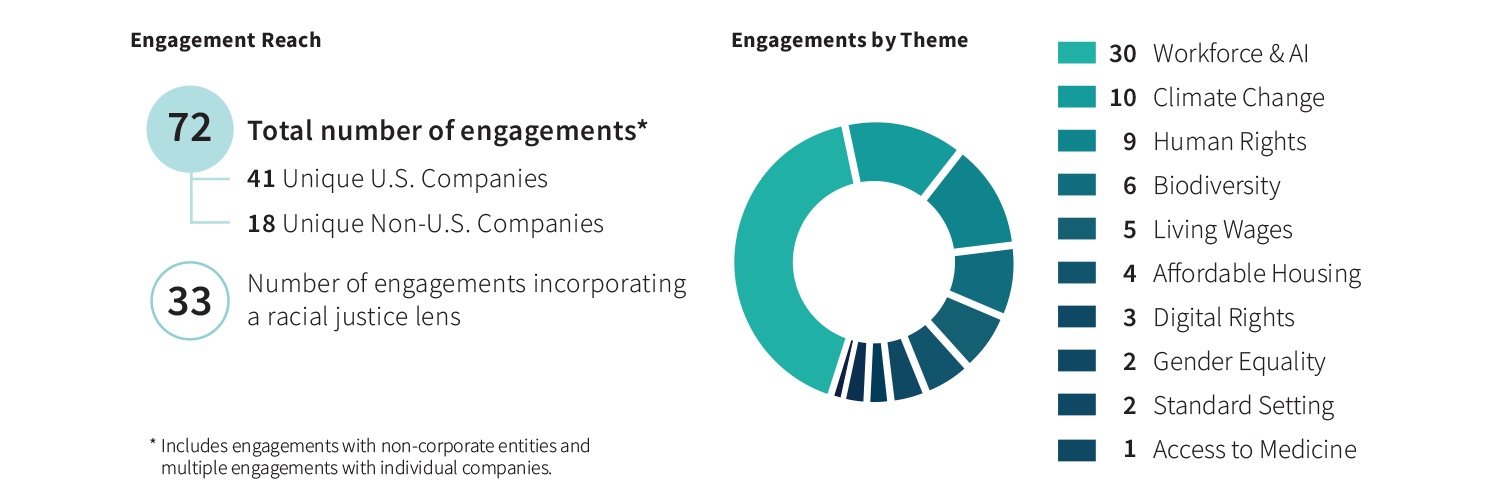
This past quarter, we wrote to 30 companies based in the United States, Europe, Japan, and Singapore. These include companies in financial services; technology and software; payroll and staffing services; and media, information, and entertainment. Many of these companies already describe investments in their workforce or in the responsible use of AI, so our focus is on understanding how these efforts connect to their overall workforce strategy. Investors are only beginning to ask companies to connect these decisions, and raising these questions early can help shape how companies plan and report on workforce impacts.
We requested dialogue on three areas. First, their overall human capital strategy, including increased disclosure of workforce data such as headcount across full-time, part-time, and contingent workers, employee turnover rates, investment in training and development, and how workforce changes affect different groups of workers. Second, how they define success for AI deployment, including measures of job quality, worker experience, customer outcomes, and long-term business resilience, alongside the efficiency gains realized. Third, from a just transition perspective, which seeks to ensure workers are treated fairly as technology changes their jobs, we asked how employees are consulted and provide input into decisions about AI, and how companies support workers through changes in roles, skills, and employment status, including access to retraining or new opportunities. We believe workers need a voice in these decisions for AI to be integrated responsibly, because they often see firsthand how new tools affect their work and the people they serve.
Through upcoming meetings with companies, we aim to benchmark disclosure, identify good practice, and shape our expectations for how companies can pursue AI investment without losing sight of the people who support their long-term success. Over the coming year, we will share what we learn with companies, highlight examples of strong disclosure, and look for clearer discussion of their workforce strategies and the role of AI.
Investment Highlight: Domini Sustainable Solutions Fund
Schneider Electric, a global energy technology company, treats AI skills as part of a broader effort to help employees grow into the roles its business will need. In 2025, 99% of employees completed its annual SE Essentials training covering cybersecurity, ethics, and AI, and 51,000 employees took at least one course through its AI Upskilling@Scale program. By the end of the year, 81% of employees had completed a development program aimed at expanding their digital skills and accelerating the adoption of AI.
Shop floor employees can access courses through Digital Learning Corners, and all employees, including part-time staff, can use its internal learning platform and Coursera, with courses leading to recognized certificates that support long-term employability. Through its AI-enabled Career Hub, available to all employees, workers can explore career paths, discover learning opportunities, and connect with internal jobs, projects, and mentors aligned with their skills. Schneider has also committed to paying all employees at or above a living wage, and since 2022, 100% of in-scope employees have been paid at least a living wage.
Reducing Emissions Across Chip Manufacturing Supply Chains



Domini’s Investment Policy Statement on Climate Change lays out our ambition to achieve net-zero portfolio-level emissions by 2050 while contributing to real-world emissions reductions. As AI drives demand for chips, semiconductor production is expanding, and so are emissions from their manufacturing. Much of the world’s advanced chip manufacturing is concentrated in a few companies and locations, many on grids that rely heavily on fossil fuels such as coal or natural gas to generate electricity. Because these manufacturers supply the whole industry, cleaner production and more efficient chips can reduce emissions far beyond any single company.
Where emissions occur varies across the value chain, and companies should report them under different categories of Scope 3, mainly purchased goods and services or customers’ use of their products. For chip designers and suppliers such as NVIDIA and Broadcom that outsource manufacturing, most emissions come from their suppliers that manufacture their chips. Broadcom has set reduction targets for emissions from its own operations but not yet for its value chain. For Advanced Micro Devices (AMD), which also designs chips, and ASML, which makes chipmaking equipment, the majority comes from customers’ use of their products, though supplier emissions remain significant and are growing with increased demand. ASPEED Technology, which makes chips used to manage servers, completed its first comprehensive value chain emissions inventory in 2025, which shows that most emissions come from customers’ product use.
This past quarter, we wrote to these five companies, which are held across several of the Domini Funds. Several already report on value chain emissions and have set climate targets, so in these cases, we focused our outreach on their largest emissions sources and what may be driving year-on-year increases. We also encouraged companies that have not yet set science-based targets to do so, consistent with our goal for all corporate holdings we assess in the Domini Funds to have validated science-based targets, or an equivalent, by 2040. We asked several of them to describe how they work with suppliers to source cleaner electricity and improve manufacturing efficiency. We also asked how they engage with utilities, customers, and policymakers on grid decarbonization to increase the share of energy produced from clean and renewable sources. We will continue to share recommendations, such as clearer disclosure of emissions sources and milestones toward absolute reductions, and encourage companies to use their significant leverage to help reduce emissions associated with the growing demand for chips.
Investment Highlight: Domini Impact International Equity Fund
MediaTek, a Taiwan-based fabless semiconductor company, designs chips and outsources their manufacturing, so much of its climate impact occurs at its suppliers and in the use of its products. The company has committed to net-zero emissions by 2050, and in 2025 it became one of the first chip design companies in Taiwan to have its near-term and net-zero targets validated by the Science Based Targets initiative (SBTi), including a 42% reduction in absolute Scope 1 and 2 emissions by 2030 from a 2023 base year. It has also set goals to reduce Scope 3 emissions by 25% by 2030 from a 2020 baseline, and to power its global offices with 100% renewable electricity by 2030.
To reach its Scope 3 goal, it sets annual targets with key suppliers to reduce emissions intensity by more than 2%, and all of its Tier 1 suppliers have obtained third-party verification of their greenhouse gas inventories and product carbon footprints. The company tracks suppliers’ renewable energy use and emissions for its product lines through an automated system, and in 2025 its joint carbon reduction projects with suppliers delivered estimated reductions of approximately 40,067 metric tons of CO2e per year.
Advancing Human Rights Due Diligence in Tech



We have long believed that technology companies have a responsibility to respect human rights not only in their policies, but in everyday decisions about their products, their customers, and the guardrails they set through their contracts. As AI expands what these technologies can do, and how they can be misused, those decisions carry even higher stakes. This past quarter, we joined more than 25 investors from three collaborative investor initiatives in a dialogue with Microsoft. Microsoft has clearly defined oversight roles for human rights at the management and board levels, along with well-defined policies and due diligence processes aligned with the UN Guiding Principles on Business and Human Rights, so the dialogue focused on understanding how its human rights program works in practice.
We asked how Microsoft uses its human rights impact assessments and related processes to strengthen how human rights are integrated across the business over time. We acknowledged the steps Microsoft has committed to after an external investigation found that a customer had used its services in violation of its terms of service, which prohibit the mass surveillance of civilians. It is strengthening its review of higher-risk contracts before they are signed and working to translate the lessons from this process into stronger due diligence across the business. We also asked how Microsoft encourages employees to raise concerns about how its technology is developed and used, including potential impacts on privacy, discrimination, or people in conflict-affected areas. We stressed that employees must be able to raise concerns without fear of retaliation, and their input should be used to reduce the likelihood of future harm.
Microsoft described how it has strengthened channels for employees to raise rights-related concerns and will look for opportunities to enhance its disclosure. We will continue to support its human rights work and share recommendations, such as enhancing disclosure of complaints received through its grievance channels and how they are addressed, or sharing examples of how its human rights reviews have shaped a product design decision. Dialogues like this help companies understand what evidence investors need that their systems work in practice, and can shape what companies report.
Investment Highlight: Domini Impact Equity Fund
NVIDIA, whose chips and software power much of today’s AI, assesses how its products are used as part of its human rights due diligence. A human rights saliency assessment of its value chain, conducted by an independent firm, identified responsible product development and responsible product use among its five most salient risks, and the findings informed updates to its Human Rights Policy in fiscal year 2026.
NVIDIA builds safeguards into both its contracts and its products. Its Trustworthy AI Terms, incorporated into applicable product agreements, prohibit uses that violate the law, including illegal surveillance and the illegal collection of biometric information. The company states that it investigates concerns that its products are being used to cause adverse human rights impacts and reserves the right to terminate or decline business that conflicts with its policy. It also publishes model cards for more than 1,000 of its AI models, explaining how each was built and should be used, and offers open-source tools, such as NeMo Guardrails, that help developers enforce safety rules and test models for vulnerabilities.
Employees, suppliers, and other stakeholders can raise human rights concerns confidentially and anonymously through a third-party hotline, and NVIDIA prohibits retaliation against anyone, including human rights defenders, who reports a concern in good faith.
Ensuring Data Center Growth Supports the Clean Energy Transition


As AI drives rapid growth in data centers, the source of the energy powering them matters for the climate, household electricity bills, and the communities where facilities are built. If new energy demand is met by extending the life of coal plants or building new gas-fired facilities, it could delay the clean energy transition and lock in fossil fuel use for decades. Through the Domini Impact Bond Fund, we have invested in debt issued by several data center developers, and this past quarter we wrote to Vantage Data Centers, Aligned Data Centers, and WULF Compute. Some of these issuers are private companies, which, in our experience, often disclose less and rarely hear from investors, so our engagement can help shape their approaches.
Many communities are questioning whether the promised investment and jobs from large new data centers outweigh the costs, and in some places residents have organized against projects over electricity prices, water use, and land. Several developers have made public commitments on clean energy, efficiency, water, and community development. States are only beginning to set rules on who pays for new power plants and grid infrastructure, which can help address the mounting affordability challenges.
Our outreach focused on how companies prioritize clean energy in site and power supply decisions and plan to transition away from any fossil fuel use; how they engage with utilities and regulators to protect nearby households from higher electricity prices; and how community input shapes projects and whether promised local benefits, such as jobs, are delivered. As projects advance, we will look for clearer reporting on power sources, associated emissions, and community commitments.
Investment Highlight: Domini Impact Bond Fund
Vantage Data Centers, which we first engaged in early 2025 on community and climate impacts, has since published its approach to responsible growth. It commits to ensuring that the full costs of new energy and grid infrastructure for its campuses are not passed on to households and small businesses. The company has set fleet-wide goals of 100% matched zero-carbon electricity and an average power usage effectiveness (PUE) of 1.25 by 2030.
At its nearly 1-gigawatt Lighthouse campus in Port Washington, Wisconsin, more than half of the power capacity is expected to come from carbon-free sources, and the project’s developers are funding about 2 gigawatts of new zero-emission power for the state’s grid. In April, Wisconsin’s utility regulator also strengthened household protections by requiring data centers and other very large customers to pay the full cost of new generation built for them, under contracts of at least 15 years. Going forward, we will look for Vantage to extend enforceable ratepayer protections across its sites and give communities pathways to shape project decisions.
Domini Impact Bond Fund: Impact Theme Allocations*
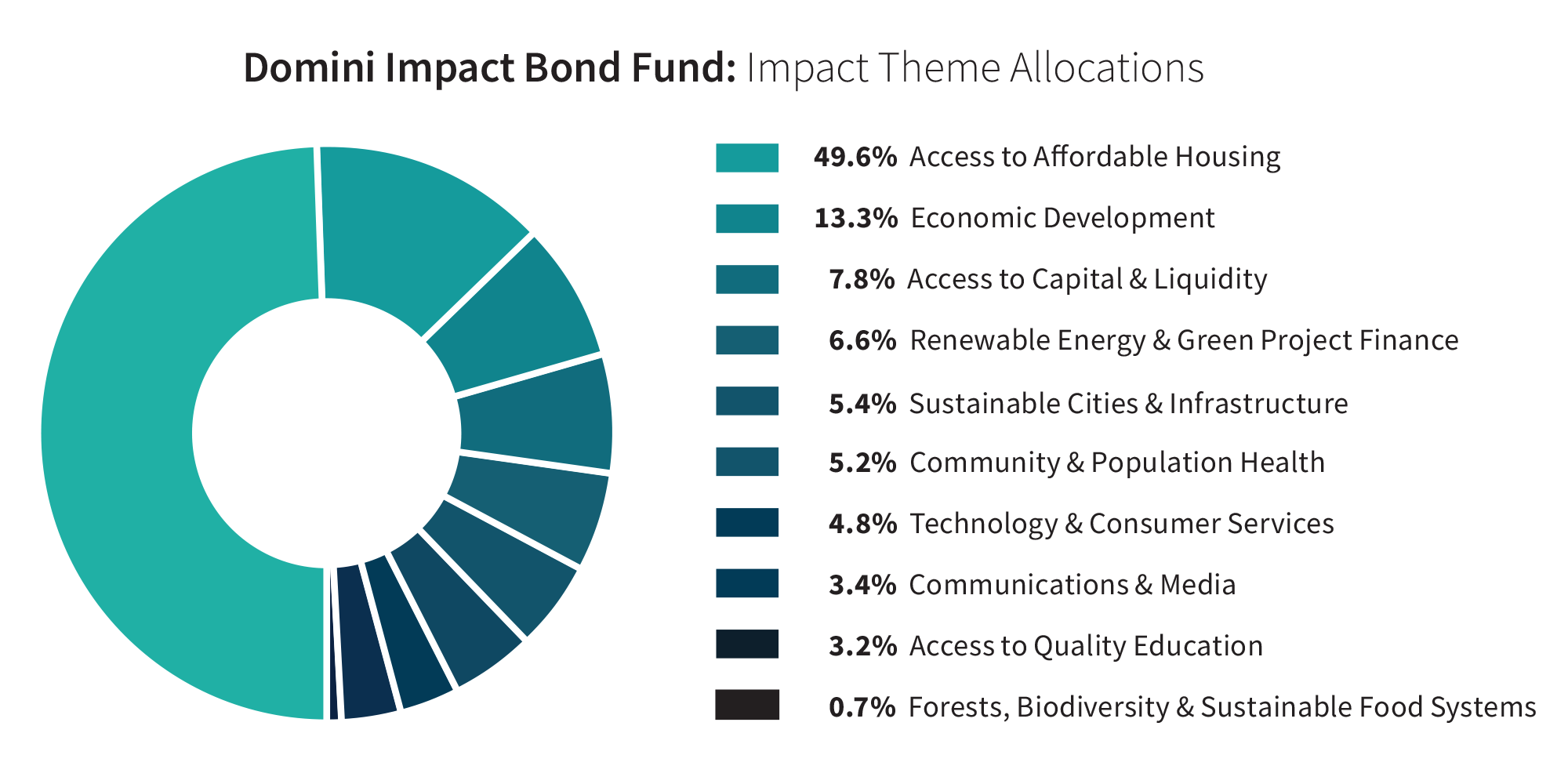
* Based on portfolio holdings as of 9/30/2026, excluding cash & cash equivalents, cash offsets, futures, swaps and options with the exception of short-term U.S. Agency bonds, which are reflected in this reporting. Numbers may not sum to 100% due to rounding. The composition of the Fund’s portfolio is subject to change. View a list of the Fund’s holdings.
New AI KPIs Strengthen Our Impact Research
By Lionella Pezza, Director of Impact Research

Artificial intelligence is rapidly changing how companies operate, how people work, and how products and services are delivered. It may help advance medical discovery, scientific research, cybersecurity, and accessibility, but it also presents material risks, including privacy violations, biased outcomes, misinformation, job displacement, and growing demands on electricity, water, and local communities.
Domini’s Standards Committee, which oversees our Impact Investment Standards, recently adopted new sets of key performance indicators, or KPIs, for two AI-related subindustries: AI Model Developers, Applications and Agents, and AI Cloud Infrastructure. They build on our Standards, which seek to advance universal human dignity and ecological sustainability, and provide more tailored guidance for evaluating AI-related business models. We evaluate companies on two levels: how closely a company’s business model aligns with our goals, and its relationships with key stakeholders, including customers, employees, suppliers, communities, investors, and ecosystems.
Both subindustries are considered partially aligned with Domini’s goals, and companies within them are evaluated case by case. The KPIs are not a substitute for internal discussion and do not function as a simple checklist. They help focus our analysis on the most important sustainability challenges, ensure consistency in our decision-making, and provide a more structured basis for our research and engagement.
AI Model Developers, Applications and Agents includes companies that design, train, deploy, or commercialize AI models, end-user tools, and agents that carry out tasks. AI Cloud Infrastructure includes pure-play providers of AI computing capacity, such as AI-focused cloud services, data centers, and networking.
For AI model developers and applications, our analysis considers the societal value of AI-enabled products and their intended and foreseeable uses. Potentially beneficial applications include health care diagnostics, scientific research, cybersecurity, and faster workflows with lower operational costs. We also assess exposure to uses that may cause significant harm, including weapons-related applications, misinformation and deepfakes, large-scale fraud, AI companion products that encourage emotional dependence among minors, and products that may undermine human rights, safety, or democratic institutions.
Responsible governance is central to this analysis. We evaluate safeguards against misuse, accountability at the board and management levels, transparency on model capabilities and pre-deployment safety testing, human oversight, privacy and data governance, and support for credible safety and regulatory frameworks. We also consider living wages and mental health support for workers who rate AI-generated outputs to train models or moderate harmful content, including subcontractors, as well as programs supporting workforce transition and STEM access for groups affected by AI displacement.
For AI Cloud Infrastructure companies, our KPIs focus primarily on the environmental and community impacts of AI facilities. We assess renewable energy procurement and investment, greenhouse gas emissions disclosure, energy and water efficiency, water sourcing, and disclosures about data center siting and local grid impacts. We consider whether new facilities may increase reliance on fossil fuels, delay fossil fuel retirements, affect household energy costs, or place added pressure on local water supplies. We also assess supply chain risks, including conflict minerals, forced labor, and worker safety.
These new KPIs apply to companies whose primary business is AI. However, AI is now embedded across sectors, and it has become difficult to draw a clear line between “AI” and “non-AI” companies. For companies in other industries that use AI or offer AI-enabled products and services, we apply the primary KPIs that are relevant for that industry, and we also pay particular attention to AI-related issues such as privacy, data use, bias, and the effects of automation on workers and communities. In some instances, we may use both sets of KPIs.
As AI evolves, we will continue to refine our research and engage companies and policymakers on emerging risks and opportunities. Through company-level analysis and system-level engagement, we seek to help shape an AI economy in which innovation advances alongside human rights, environmental stewardship, accountability to affected communities, and broadly shared benefits.
Learn more about how we apply our Impact Investment Standards to AI.
Domini News

Domini at Climate Week NYC and Beyond
In September, Domini joined investors, companies, policymakers, and civil society leaders in New York for Climate Week NYC, one of the world’s largest annual climate events. Domini sponsored Transition-IQ’s Climate Week NYC Forum, which brought together asset owners, consultants, and investment managers to discuss climate risk and opportunity, and CEO Carole Laible spoke on a panel about nature-related risks, a topic she also addressed earlier in the month at Environmental Finance’s Natural Capital Investment Americas 2026.
Director of Engagement Mary Beth Gallagher led a facilitated investor workshop that Domini hosted during Climate Week, “Grievance and Remedy in Just Transition for Vulnerable Groups.” The clean energy and digital transitions can create serious risks for workers and communities, and these risks are increasingly showing up for companies as project delays and local opposition. The workshop is part of our work to build an investor community of practice on grievance and remedy.
Mary Beth also spoke at several other events. At Environmental Finance’s Sustainable Debt Americas 2026, she moderated a fireside chat on why bondholder engagement matters more than ever. At the Nature Hub during Climate Week, she drew on her role as Chair of the Advisory Board of the Finance for Biodiversity Foundation to share how the financial sector is taking action on nature ahead of the UN Biodiversity Conference (COP17). And on a September 30 webinar hosted by Shift, the nonprofit center of expertise on the UN Guiding Principles on Business and Human Rights, she discussed how financial institutions can strengthen human rights due diligence as AI reshapes risks to workers and communities.

Domini and CEO Carole Laible Named Industry Award Finalists
Domini CEO Carole Laible has been named an Excellence Awardee, a finalist designation, in the Executive Excellence category of the 2026 InvestmentNews Women to Watch Awards, which celebrate women who are reshaping the financial services industry. Category winners will be announced on November 5, 2026.
Carole and Domini have also been named finalists for the 2026 ThinkAdvisor Luminaries Awards, which recognize leadership, innovation, and impact across financial services. Domini is a finalist in the Thought Leadership and Education (Firm) category, and Carole is a finalist for CEO of the Year. Domini’s nomination highlighted the Domini Funds 2025 Impact Report. Winners will be announced on December 3, 2026.
“This recognition belongs to the entire Domini team,” said Carole. “Since day one, we’ve worked to prove that investors can align their values with their financial goals, and every day, our team shows up to make that mission real.”
Sustainable Development Goals
In the decade since United Nations member states adopted the 2030 Agenda for Sustainable Development, the Sustainable Development Goals (SDGs) have been widely embraced by governments, civil society organizations, companies, and investors. The SDGs aim to address broad global topics such as poverty eradication, food security, protection of forests, sustainable cities, economic growth, gender equality, and climate change. Engagement highlights in this report are flagged with the SDGs they are helping support. Learn more about our support for the goals.
